JAKARTA — China has shown strong interest in buying a massive haul of shipwreck treasures ... salvaged in 2004 off Cirebon, West Java.I find treasure troves to be endlessly fascinating. A quick Google search for Cirebon + treasure yielded a lot of hits, including this New York Times story from 2006.
"We held talks with the Chinese government and our plan is to keep these treasures in museums in China and Indonesia," Kabul told AFP. "I think it will the best solution so that this rich treasure will be preserved properly by museum experts," he said adding that both countries had not reached any agreement yet as details were still being discussed.
The collection comprises some 271,000 pieces including rubies, pearls, gold jewellery, Fatimid rock-crystal, Persian glassware and exquisite Chinese imperial porcelain dating back to the late 10th century.
Belgian treasure hunter Luc Heymans who conducted the salvage operation said it was one of the biggest shipwreck treasures ever found in Asian waters.

Tampilkan postingan dengan label treasure. Tampilkan semua postingan
Tampilkan postingan dengan label treasure. Tampilkan semua postingan
Rabu, 02 Maret 2011
An incredible 10th century shipwreck treasure

Pirates and privateers on the "maritime silk road"

We consider first the blurred boundaries between piracy, privateering and freebooting:The post then goes on to detail the impressively dangerous passage noted at the red dot on the map (the Singapore and Malacca Straits), and the capture of the Santa Catarina in 1603. The ship's cargo "became legendary" -“…piracy, privateering (and the latter’s legal offshoot, freebooting) represent from the vantage point of European legal definitions quite distinct activities. Piracy is committed by private persons who have banded together and removed themselves from society at large and thus also from the protection of the law. Pirates were deemed enemies of the people and of the state. Privateering, by contrast, is a concept closely associated with the idea of the just war… Privateers operated under a so-called letter of marque and reprisal (Dutch: kaperbrief, commissie van retorsie), but they were technically only supposed to be issued with a letter of marque if they actually had suffered damage earlier by the enemy. The letter of marque, thus, permitted the seizure of goods from the (declared) enemy as a form of war reparation. This logic limited prizetaking to vessels sailing under enemy flag (or the flags of enemy allies) and only during times of war… This was how privateering was designed to work from a theoretical, legal vantage point. Actual practice was naturally quite different, and privateering effectively grew into a practice the full-blown proportions of which could have not been foreseen or anticipated in the late sixteenth or even the early seventeenth century…With large prizes to be taken, it was not surprising that increasingly, letters of marque were issued after the event, irrespective of whether their captains had suffered damage, and with rapidly increasing trade, the problem was to escalate sharply in the latter part of the 17th century.
The late sixteenth and early seventeenth centuries–European privateers were authorized to seize commercial vessels of the (declared) enemy under direct and explicit instructions of their government, ruler or home port. A freebooter (from the Dutch: vrijbuiter; German: Freibeuter), a closely related term, was someone who may have captured a vessel authorized by a letter of marque, in an act of self-defence or reprisal and under the laws of war, but subsequently sold the captured goods on the open market without awaiting the verdict of the local admiralty court, declaring the seized vessel “good prize” and without also ceding to the home authorities their due share of the booty, the so-called gerechtigheit van het land. Failure to await the verdict and surrender this share – customarily 20 percent – to the home Admiralty Board technically rendered the act of prize-taking “illegal”, or at least highly problematic, from the vantage point of the home government. In other words, failure to abide by what in the course of the seventeenth and eighteenth centuries grew into a myriad of procedures and regulations edged an act of privateering into the shadow of piracy...“…privateering practice led to the development of a particular type of sea robber, who, unlike the corsairs and merchant warriors of the sixteenth and early seventeenth centuries, was not committed to serve a single nation but operated on a ‘freelance’ basis for one sovereign after another, or for several at the same time… Unscrupulous sea robbers of this kind were so dangerous precisely because they always found the support of some nation or other, and were never the enemies of all nations at once.”
There is a lot more information at Poemas del rio Wang.“1,200 bales of raw Chinese silk; chests filled with coloured damask, atlas (a type of polished silk), tafettas and silk; large amounts of gold thread or spun gold; cloth woven with gold thread; robes and bed canopies spun with gold; silk bedcovers and bedspreads; linen and cotton cloth, thirty last (approximately sixty tonnes) of porcelain comprising dishes ‘of every sort and kind’; substantial quantities of sugar, spices, gum, musk (also known as bisem); wooden beds and boxes, some of them beautifully ornate with gold; and a ‘thousand other things, that are produced in China’” (Borschberg).Merchants from all over Europe attended the auction in Amsterdam. The sale realised 3.5 million Guilders, half the capital-base of the VOC. Yet extraordinary as this was, the cargo was not unusual. No wonder the Dutch were determined to press their case for unfettered access to the East.
Minggu, 20 Februari 2011
Love tokens retrieved from the mud of the Thames


From the end of the eighteenth century and until the early twentieth century, smoothed coins were used as love tokens, with the initials of the sender engraved or embossed upon the surface. Sometimes these were pierced, which gave recipient the option to wear it around the neck. In Steve’s collection, the tokens range from heavy silver coins with initials professionally engraved to pennies worn smooth through hours of labour and engraved in stilted painstaking letters. In many examples shown here, the amount of effort expended in working these coins, smoothing, engraving or cutting them is truly extraordinary, which speaks of the longing of the makers.Pictured above: "The intials M and W intertwined upon a Georgian silver coin, a pierced coin set with semi-precious stones, and cut coins from the early twentieth century." Another dozen photos at the link.
For other, non-coin-related, retrievals from the mud, see this interesting link.
Via A London Salmagundi.
Rabu, 05 Januari 2011
Is $10 billion buried on Robinson Crusoe Island?

Keiser, whose treasure-seeking effort on the island the past 12 years has cost him an estimated US$2 million, is reportedly in the process of shelling out another US$100,000 dollars for this latest effort, which includes highly sophisticated mining video technology.More details on the story of the treasure and new developments in the quest are available at Death by 1000 Papercuts. See also my two posts in 2009 about archaeological digs on the island, here and here.
But Keiser’s expenses will be well covered should he find the treasure: Chilean law will provide him 25 percent of any booty he discovers, and Keiser estimates the treasure’s value at US$10 billion.
According to legend, the treasure originated in the Incan Empire and was stolen during the Spanish conquest of Peru in the 16th and 17th centuries. When the treasure was en route to Spain around 1715, the navigator in charge of the ship landed on Robinson Crusoe Island and buried his cargo. Before he could return to unearth the booty, an English pirate named Cornelius Webb uncovered the Incan treasure and reburied it elsewhere on the island. The legendary stash is reported to contain 800 barrels of gold, including precious pieces of gold and jewelry.
Jumat, 17 Desember 2010
Roman coin treasure hoard

... What he found that afternoon is now stacked in a waist-high pile of shoe box-sized cardboard boxes, in a corner of an office in the coins department of the British Museum – a Diagon Alley place of mysteries, on two floors, protected by a three-inch-thick strongroom door.The rest of the story is at The Guardian.
The boxes hold the contents of a giant potbellied jar which lay in the clay of that sloping Somerset field for almost 2,000 years, filled to overflowing with the largest coin hoard ever found in a single container in Britain. "You can see what a job it's going to be to clean the horrors," Sam Moorhead, a Roman coins specialist, says fondly, running through his fingers a handful of disgusting bits of metal, green with corrosion, ragged with welded-on bits of other broken coins. Studying the 52,503 of them that are legible will occupy the experts for the rest of their careers...
... an expert committee met at the British Museum, and after hours of debate and three widely varying outside opinions on the value of the hoard, finally set a price of £320,250 on the coins, to be shared between Crisp and the landowners, Geoff and Anne Sheppard...
The conventional explanation is that these hoards are either underground piggy banks, or stashed in times of danger to be recovered when normal life resumes – or never, if the feared catastrophe overwhelms the owner... But the Frome hoard doesn't match that picture at all...
Moorhead is convinced the Frome hoard represents a stupendous offering of as much cash as the community could raise. The swords and bronze shields their ancestors threw into rivers and springs were gone, and coins were the easiest way of assembling a massive quantity of metal...
Photograph: British Museum/PA
Rabu, 01 Desember 2010
Gold boat from the Broighter Hoard

The hoard was found near Lough Foyle in a field between Ballykelly and Limavady in County Londonderry. It was discovered by Thomas Nicholl and James Morrow while working as ploughmen for Joseph L. Gibson in February 1896. They found the hoard whilst double ploughing. That means that one plough would follow the other to gain extra depth. It was estimated that the finds were buried 14 inches (36 cm) deep and were in close proximity to each other.What boggles my mind is the delicacy of the work and the antiquity of the piece: The material probably dates from the first century BC.
The find was taken to the farm where Maggie (later Mrs Nicholl) washed the items in a sink. At that time they did not realise they were made from gold. The hoard was eventually sold to the British Museum for six hundred pounds. It consisted of a miniature ship, complete with fittings and oars; two necklets, a bowl and a torc (or hollow collar). The find was described as a lump of mud when initially shown. Moreover the boat had been so badly damaged by the plough that it took a goldsmith to later work out its structure...
The boat was measured at 7.25 inches (18.4 cm) by 3 inches (7.6 cm) and weighed 3 ounces (85 g). It had benches, rowlocks, two rows of nine oarsmen and a paddle for steering. It also included tools for grappling, three forks, a yardarm and a spear.
Via Uncertain Times.
Senin, 29 November 2010
Treasures from Afghanistan


"Pair of pendants depicting the Dragon Master in gold, turquoise, garnet, lapis lazuli, carnelian, and pearl. These elaborate hair ornaments depict a man wearing the tunic and flowing pants typical of nomadic dress. He holds two dragon-like creatures by their forelegs, a mythic scene known from ancient Persian and Siberian art that suggests power and invincibility" andAbout ten more items at the link.
"Gold, turquoise, and carnelian boot buckles depicting a chariot drawn by dragons (Tillya Tepe, Tomb IV), 1st century BC-1st century AD."
Jumat, 19 November 2010
3-year-old boy finds £2.5m treasure

A three-year-old boy using a metal detector for the first time has unearthed a gold pendant estimated to be worth over £2.5m. James Hyatt made the discovery while out with his father and grandfather in Hockley, Essex. He had only been scanning the soil for a matter of minutes when it started beeping...I am recurrently in awe of the common sense approach British law takes to treasured discoveries. In other countries the government would claim/try to grab the item, so instead of turning it in, the finder would probably melt this down and sell the gold lump to a jeweler.
Experts believe the rare locket, or reliquary, dates back to the 1500s and was used to hold alleged parts of Christ's crown of thorns or crucifix...
An inquest has declared the reliquary treasure trove and it could be bought for millions by an interested institution, including the British Museum. Proceeds will be split with the family and the owner of the field where the pendant was found.
Found at Nothing to do with Arbroath.
Rabu, 17 November 2010
"Clipped" Roman coins

I was reading today about the "Hoxne hoard," which included almost 15 THOUSAND Roman gold, silver, and bronze coins. Apparently clipping was rampant in that era; almost every silver siliqua in the hoard has been clipped. I found it interesting that a second reason was given for coin clipping: "a deliberate attempt to maintain a stable ratio between gold and silver coins."
Jumat, 12 November 2010
This vase just sold for $85,000,000
I find it interesting that it is not that old (by Chinese standards). Presumably the provenance of belonging to an emporer contributed to the buying frenzy.A vase found in a house clearance in London has been sold for £43m, thought to be a record for any Chinese artwork... The 18th Century Qianlong porcelain piece, found in Pinner, had been estimated to fetch up to £1.2m for the brother and sister who inherited it.
Ivan Macquisten, editor of Antiques Trade Gazette, said the vase would have been made for the Qianlong emperor. The 16in high vase is yellow and sky blue in colour with a fish motif on the front and a perforated outer wall...
The ceramic vase was made during the reign of the fourth emperor in the Qing dynasty who ruled the empire from 1735 to 1796.
It is thought the vase left China in about 1860 and was acquired by an English family during the 1930s but how it made its way to the bungalow in Pinner is a mystery, the auctioneer said.
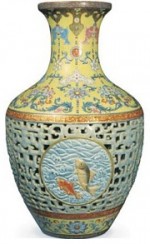
Photo - Bloomberg
Jumat, 24 September 2010
Impressive gold "nugget"
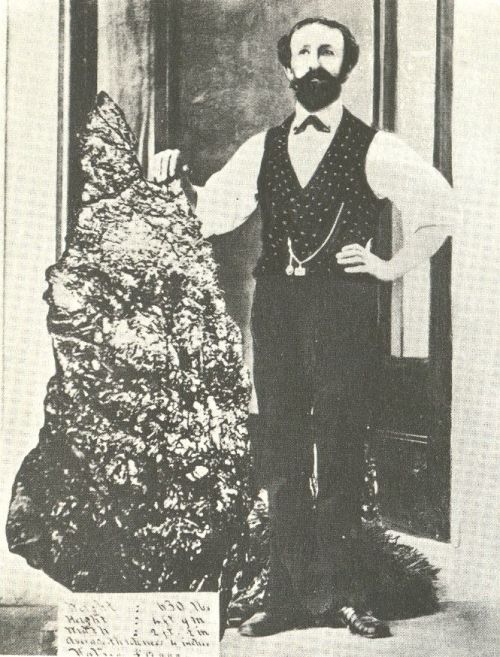
"German prospector Bernhard Otto Holtermann with a mass of nearly all solid gold, Hill End, New South Wales, 1872. The gold weighed 630lb & valued at 12,000 pounds."Would be worth a lot more today.
Found at The Fighting Temeraire, or Everything 19th Century.
Rabu, 15 September 2010
British treasure-hunter finds Roman helmet and mask

A Roman bronze helmet complete with face-mask - thought to be one of only three of its kind to be found in Britain - has been discovered by a metal detector enthusiast in Cumbria...
The helmet, with its enigmatic and virtually intact features, would have been worn, possibly with colourful streamers attached to the object, as a mark of excellence by Roman soldiers at cavalry sport parades.
Described as a ''hugely important discovery'', it is now expected to fetch £300,000 at Christie's Antiquities auction in London...
Selasa, 07 September 2010
Finding neat stuff in the back yard

David Murray, 39, was digging behind his bungalow when he unearthed a dog tag from a German prisoner. He got permission from his landlord to continue excavations and within an hour he had located old bottles, buttons from uniforms and used ammunition...Via Nothing to do with Arbroath.
David has now recovered more than 2,000 items from the camp, including a live GRENADE that had to be blown up by a RAF bomb disposal unit...
”It’s really incredible to think that 70 years ago 10,000 prisoners of war were walking around in my back garden.”
The Wynches Camp opened in 1939 and first housed Italian prisoners, but later took Germans – some of whom did not leave until 1947. The 40-acre camp, which held up to 10,000 prisoners, was situated in Much Hadham, and David’s landlord owns 20 acres of the land it stood on...
Senin, 30 Agustus 2010
Two gold coins


Found at FOX News. Credits: AP Photo/Tara Todras-Whitehill (top) and AP (bottom).
Minggu, 29 Agustus 2010
This silver dollar just sold for $1.2 million

The story goes that on Oct. 15, 1794, chief coiner Henry Voigt coined the silver dollars and delivered all the acceptable ones, 1,758 of them, to David Rittenhouse, director of the US Mint, according to the Smithsonian Museum of American History. He handed them out as gifts to dignitaries...
Only 140 of the 1794 so-called Flowing Hair silver dollars are thought to exist. (The coins depict a woman with long flowing hair)... The $1 coin that sold in Boston to an anonymous bidder was considered the fourth best specimen of the six mint 1794 silver dollars known to exist. The best specimen, called the Neil/Carter/Contursi 1794 Flowing Hair silver dollar, sold for nearly $7.9 million in May, setting a new record price for a coin.
Kamis, 15 Juli 2010
Treasure hunter finds 52,000 Roman coins in the UK

The hoard, which was valued at 3.3 million pounds ($5 million), includes hundreds of coins bearing the image of Marcus Aurelius Carausius, who seized power in Britain and northern France in the late third century and proclaimed himself emperor.More details at Arab News. CNN has a photo of the pot of coins.
Dave Crisp, a treasure hunter using a metal detector, located the coins in April in a field in southwestern England, according to the Somerset County Council and the Portable Antiquities Scheme.
The coins were buried in a large jar about a foot (30 centimeters) deep and weighed about 160 kilograms (350 pounds) in all...
"I put my hand in, pulled out a bit of clay and there was a little radial, a little bronze Roman coin — very, very small, about the size of my fingernail," Crisp said in an interview with the BBC.
He recovered about 20 coins before discovering that they were in a pot, and realized he needed expert help.
"Because Mr. Crisp resisted the temptation to dig up the coins it has allowed archaeologists from Somerset County Council to carefully excavate the pot and its contents, ensuring important evidence about the circumstances of its burial was preserved," said Anna Booth, of Somerset Council.
I've repeat here my previous comment that the UK leads the world in the handling of discovered treasure:
The Brits are to be endlessly commended for their thoroughly enlightened policy regarding the discovery of buried treasure. The law of the land gives half the value of the find to the person who discovers it. In many (?most) countries the government tries to confiscate anything found or repatriate it to presumed descendents, with the result that magnificent finds like the above from the whole of the world's history are routinely sold on the black market to wealthy people who hide it, or worse yet, melted down for base metal value by "potholers" ravaging archaeologic sites. Kudoes to the Brits for rewarding the finders and preserving their heritage.For a sad comparison, see the post below this on the situation in Iraq.
Sabtu, 06 Februari 2010
"Always look in drawers"
Re the Tamerlane pamphlet above -In the recently published account of John Gilkey, Allison Bartlett’s The Man Who Loved Books Too Much, which is set to become a classic of its kind, a dealer recounts viewing an auction in London and finding in a bureau drawer a copy of Blake’s Book of Job in which had been tucked his even rarer Song of Liberty. The bureau was estimated at about $2,000, the Job was worth at least $100,000. Obviously rejecting the Gilkey option of trousering the book and walking out of the room with it, the dealer, oddly, decided not to bid for the chest either. He doesn’t say why, but he may have reasoned that someone else had noticed the book and had decided to bid, prompting a bidding war. Or, perhaps someone had opted to steal the book at some point, in which case our friend would need to keep his eyes on the chest almost up to the point of sale. As it was, the dealer informed the auction house of the hidden treasure before the chest was sold. The four-page Song of Liberty was duly removed and later fetched $25,000 at auction. We are not told what happened to the Job.

One of the rarest first editions in American literature, Tamerlane and Other Poems , a forty page pamphlet published pseudonymously at his own expense in 1827 by the 17 year old Edgar Allan Poe, was found in a box of agricultural pamphlets in a New Hampshire antiques barn in 1988 by a lucky dealer who recognised its worth and secured it for $15. Only a dozen copies are said to exist. This one sold not long afterwards at Sotheby’s for $198,000.
Langganan:
Postingan (Atom)