Back in 1887, a Rock Co. farmer named August Kramer had trouble with his teeth. He finally went to a Janesville dentist named A.P. Burrows, who recommended replacing them all. Mr. Kramer soon possessed a full set of false teeth, both uppers and lowers, instead of his worn out originals.
For nearly two decades, Mr. Kramer was pleased with his investment and the dentures worked perfectly well. They probably would have served him for anther 20 years if he had not abruptly passed away in 1907.
His grief-stricken widow accompanied his body to the undertaker, where she made a peculiar request. She asked if her husband's false teeth could be removed from his body just before it was entombed in his coffin. She explained that "she would soon be obliged to purchase a set" herself and saw no reason for letting a perfectly good pair go to waste. Her request was granted.
Two years later she called upon the dentist that had made the dentures for her husband all those years ago, and Dr. Burrows successfully retrofitted them for her own mouth.
As she walked out of his office with her second-hand teeth in place, she told him that she hoped the dentures would "make her look thirty years younger" because she was hoping to "soon again enter the matrimonial class."

Tampilkan postingan dengan label history. Tampilkan semua postingan
Tampilkan postingan dengan label history. Tampilkan semua postingan
Rabu, 09 Maret 2011
Recycling false teeth
A story from the Wisconsin Historical Society, via the Wisconsin State Journal:

Selasa, 08 Maret 2011
Ancient Nubians consumed tetracycline-laced beer

A chemical analysis of the bones of ancient Nubians shows that they were regularly consuming tetracycline, most likely in their beer. The finding is the strongest evidence yet that the art of making antibiotics, which officially dates to the discovery of penicillin in 1928, was common practice nearly 2,000 years ago.Fascinating.
The research, led by Emory anthropologist George Armelagos and medicinal chemist Mark Nelson of Paratek Pharmaceuticals, Inc., is published in the American Journal of Physical Anthropology...
Armelagos is a bioarcheologist and an expert on prehistoric and ancient diets. In 1980, he discovered what appeared to be traces of tetracycline in human bones from Nubia dated between A.D. 350 and 550, populations that left no written record. The ancient Nubian kingdom was located in present-day Sudan, south of ancient Egypt...
“The bones of these ancient people were saturated with tetracycline, showing that they had been taking it for a long time,” he says. “I’m convinced that they had the science of fermentation under control and were purposely producing the drug.”..
Even the tibia and skull belonging to a 4-year-old were full of tetracycline, suggesting that they were giving high doses to the child to try and cure him of illness, Nelson says.
The first of the modern day tetracyclines was discovered in 1948. It was given the name auereomycin, after the Latin word “aerous,” which means containing gold. “Streptomyces produce a golden colony of bacteria, and if it was floating on a batch of beer, it must have look pretty impressive to ancient people who revered gold,” Nelson theorizes.
Did Henry VIII carry the Kell antigen and have McLeod syndrome?
Excerpts from a report at ScienceDaily:
Research conducted by bioarchaeologist Catrina Banks Whitley while she was a graduate student at SMU (Southern Methodist University) and anthropologist Kyra Kramer shows that the numerous miscarriages suffered by Henry's wives could be explained if the king's blood carried the Kell antigen. A Kell negative woman who has multiple pregnancies with a Kell positive man can produce a healthy, Kell positive child in a first pregnancy; But the antibodies she produces during that first pregnancy will cross the placenta and attack a Kell positive fetus in subsequent pregnancies.Very interesting. Here's a link to Whitley and Kramer's publication.
As published in The Historical Journal (Cambridge University Press), the pattern of Kell blood group incompatibility is consistent with the pregnancies of Henry's first two wives, Katherine of Aragon and Anne Boleyn. If Henry also suffered from McLeod syndrome, a genetic disorder specific to the Kell blood group, it would finally provide an explanation for his shift in both physical form and personality from a strong, athletic, generous individual in his first 40 years to the monstrous paranoiac he would become, virtually immobilized by massive weight gain and leg ailments...
A Kell positive father frequently is the cause behind the inability of his partner to bear a healthy infant after the first Kell negative pregnancy, which the authors note is precisely the circumstance experienced with women who had multiple pregnancies by Henry. The majority of individuals within the Kell blood group are Kell negative, so it is the rare Kell positive father that creates reproductive problems...
McLeod syndrome resembles Huntington's disease, which affects muscle coordination and causes cognitive disorder. McLeod symptoms usually begin to develop when an individual is between 30 and 40 years old, often resulting in damage to the heart muscle, muscular disease, psychiatric abnormality and motor nerve damage. Henry VIII experienced most, if not all, of these symptoms, the authors found...
The precise number of miscarriages endured by Henry's reproductive partners is difficult to determine, especially when various mistresses are factored in, but the king's partners had a total of at least 11 and possibly 13 or more pregnancies. Only four of the eleven known pregnancies survived infancy. Whitley and Kramer call the high rate of spontaneous late-term abortion, stillbirth, or rapid neonatal death suffered by Henry's first two queens "an atypical reproductive pattern" because, even in an age of high child mortality, most women carried their pregnancies to term, and their infants usually lived long enough to be christened...
The survival of Mary, the fifth pregnancy for Katherine of Aragon, fits the Kell scenario if Mary inherited the recessive Kell gene from Henry, resulting in a healthy infant.
Old Leatherman

From 1856 to about 1882, he roamed the countryside until he began a now-famous clockwise circuit of 365 miles every 34 days, a route he followed for about seven years until his death in 1889...The modern controversy centers around whether his body should be exhumed from its current mislabeled pauper's grave, subjected to forensic testing, and relocated to a different site. You can read about that at the NYT or BoingBoing.
“What we do know is that as people got to know him, they feared him less and less and opened their homes to the Leatherman. It became an honor to feed him. People would miss church socials if they knew he was going to come through town, and these weren’t just ordinary townsfolk. Pretty prominent people helped him as well.”
Ms. Sutton said tanneries often left good scrap leather out for the Leatherman to use in repairing his suit, while townspeople left out food, tobacco and even money...
He was referred to as old, Ms. Sutton speculates, due to his grimy appearance and depressed demeanor. His clothing was pieced together out of small pieces of leather, stitched with wider strips of leather, which was worn over woolen underclothes...
Senin, 07 Maret 2011
Here's a One-and-two-thirds-dollar bill


I found it in the collections of the National Museum of American History at the Smithsonian. The photos are of marginal quality, but are supplemented by this description:
The note is worn, and, in common with several of its fellows, it was carefully stitched together, obscuring part of the design. But if we could see everything, we would see that, on the front of the note, a figure representing Great Britain receives a petition of the Continental Congress. It is handed to her by an America, who is simultaneously trampling on a scroll marked SLAVERY and holding aloft a Liberty cap on a pole, a beacon for American troops who are hastening to the scene from the right.That explains the design, but not the curious denomination. There were no American "dollars" until 1792, so the dollar referenced in this bill would have been the Spanish one. But why have the bill in such an odd multiple? Any numismatists out there have ideas?
Meanwhile, George III (the figure at the center-left) is doing his best to set fire to an American city (perhaps Baltimore) already under attack from a British fleet. He's also trampling a copy of Magna Charta, just to underscore the point. Inscriptions along the sides read "AN APPEAL TO HEAVEN" and "PRO ARIS ET FOCIS" (For altars and hearths). The other side of the note conveys hope. Britain and America are shown achieving peace, with the reminder that "PAX TRIUMPHIS POTIOR" (Peace is preferable to victory).
The note was designed by Annapolis silversmith Thomas Sparrow in the summer of 1775. His initials are inscribed on the front and his full name on the back. This series of Maryland notes remains the most politically charged currency ever issued in the United States during wartime.
Jumat, 04 Maret 2011
Roman bridge in Iraq

"Roman bridge, Eski Mosul, with policeman on the right. Cat. Stein LHAS Photo 23/1 (38).
Photo by the Hungarian-British archaeologist Aurel Stein reconstructing the route of Alexander the Great in Persia, 1930s.
First publication: the Aurel Stein site of the Library of the Hungarian Academy of Sciences prepared by us, April 2008."
From the ever-interesting Poemas del rio Wang, which has a second photo (?of the same bridge). I presume there was some sort of ramp structure or additional arches, and that the working bridge would have looked something like this one:

The Iraqi bridge is very cool, but I presume it is probably long gone now.
Kamis, 03 Maret 2011
Queen Victoria's final companion

"I am so very fond of him. He is so good and gentle and understanding… and is a real comfort to me.”Fascinating.
These were the words of Queen Victoria speaking to her daughter-in-law, Louise, Duchess of Connaught, on November 3, 1888, at Balmoral. Perhaps surprising, though, is who she was talking about – not her beloved husband, Albert, who had died in 1861. Nor John Brown, her loyal Scottish ghillie, who in many ways filled the void left by Albert, since Brown had died in 1883.
Instead, Queen Victoria was referring to Abdul Karim, her 24-year-old Indian servant.
Her relationship with Karim was one that sent shockwaves through the royal court – and ended up being one of the most scandalous periods of her 64-year reign.
Indeed, such was the ill-feeling that when Victoria died, her son King Edward ordered all records of their relationship, including correspondence and photographs, to be destroyed.
But a new archive of letters, pictures and Karim’s “lost diary”, held secretly by his family for more than a century, sheds new light on their relationship.
The documents tell the story of how Karim arrived in England in 1887 and quickly gained the affection of a monarch 42 years his senior. They chart the remarkable rise of the clerk from Agra in northern India to one of Victoria’s closest and most influential friends...
The author Shrabani Basu discovered the documents after writing Victoria & Abdul, her book on the remarkable relationship between the Queen and her Indian servant... Basu flew from London to Karachi in Pakistan. She was handed the diary – a neat brown journal with gold edges, recognisable as the stationery used in Windsor. It contained a record of Karim’s 10 years in London between the Golden and Diamond jubilees. The pages were also filled with photographs and magazine cuttings. It had been smuggled out of India by the family when they had fled in 1947 following the Partition riots, then kept a closely guarded secret until Basu’s visit...
Karim introduced curry to the royal menu and started teaching her to speak Urdu, offering lessons every evening. As Empress of India – and a committed Indophile – nothing pleased her more...
Henceforth Karim travelled everywhere with the Queen, even on her tours of Europe, meeting numerous monarchs and prime ministers along the way. The Queen allowed him to move his wife over to England, and the couple were given their own cottage on each of her estates...
Still, many in the royal court were unhappy with Karim’s constant presence. He was forever by her side and the Queen, a prolific letter-writer, often sent him several letters a day... The courtiers’ fears had some substance. Since Karim saw every letter that the Queen sent, he was soon advising her on how to deal with sectarian problems between Muslims and Hindus – advice she passed on to the bemused Viceroy. Unsurprisingly, her solutions always seemed to favour the Muslims – Karim, of course, was a Muslim...
Abdul had created a phrase book of everyday Urdu words for the Queen to use when speaking to her Indian servants, as well as visiting royalty, and has written them out in Roman script.
The phrases include the standard ones such as: “You may go home if you like” (Tum ghar jao agar chhate ho); and: “The egg is not boiled enough”.
But some of the phrases are significantly more intriguing. For instance: “You will miss the munshi very much” (Tum munshi ko bahut yad karoge). And: “Hold me tight” (Ham ko mazbut thamo)...
The Windsor documents also contain letters from Queen Victoria to Karim, frequently concerning his wife (towards whom, it would appear, she was equally fond), signed: “dearest mother”; or “Your loving mother, Victoria R.I.”
She nearly always signed these in Urdu.
(Extracted from 'Victoria & Abdul’ by Shrabani Basu, published by The History Press March 7.)
Rabu, 02 Maret 2011
Wartime communications center

Pirates and privateers on the "maritime silk road"

We consider first the blurred boundaries between piracy, privateering and freebooting:The post then goes on to detail the impressively dangerous passage noted at the red dot on the map (the Singapore and Malacca Straits), and the capture of the Santa Catarina in 1603. The ship's cargo "became legendary" -“…piracy, privateering (and the latter’s legal offshoot, freebooting) represent from the vantage point of European legal definitions quite distinct activities. Piracy is committed by private persons who have banded together and removed themselves from society at large and thus also from the protection of the law. Pirates were deemed enemies of the people and of the state. Privateering, by contrast, is a concept closely associated with the idea of the just war… Privateers operated under a so-called letter of marque and reprisal (Dutch: kaperbrief, commissie van retorsie), but they were technically only supposed to be issued with a letter of marque if they actually had suffered damage earlier by the enemy. The letter of marque, thus, permitted the seizure of goods from the (declared) enemy as a form of war reparation. This logic limited prizetaking to vessels sailing under enemy flag (or the flags of enemy allies) and only during times of war… This was how privateering was designed to work from a theoretical, legal vantage point. Actual practice was naturally quite different, and privateering effectively grew into a practice the full-blown proportions of which could have not been foreseen or anticipated in the late sixteenth or even the early seventeenth century…With large prizes to be taken, it was not surprising that increasingly, letters of marque were issued after the event, irrespective of whether their captains had suffered damage, and with rapidly increasing trade, the problem was to escalate sharply in the latter part of the 17th century.
The late sixteenth and early seventeenth centuries–European privateers were authorized to seize commercial vessels of the (declared) enemy under direct and explicit instructions of their government, ruler or home port. A freebooter (from the Dutch: vrijbuiter; German: Freibeuter), a closely related term, was someone who may have captured a vessel authorized by a letter of marque, in an act of self-defence or reprisal and under the laws of war, but subsequently sold the captured goods on the open market without awaiting the verdict of the local admiralty court, declaring the seized vessel “good prize” and without also ceding to the home authorities their due share of the booty, the so-called gerechtigheit van het land. Failure to await the verdict and surrender this share – customarily 20 percent – to the home Admiralty Board technically rendered the act of prize-taking “illegal”, or at least highly problematic, from the vantage point of the home government. In other words, failure to abide by what in the course of the seventeenth and eighteenth centuries grew into a myriad of procedures and regulations edged an act of privateering into the shadow of piracy...“…privateering practice led to the development of a particular type of sea robber, who, unlike the corsairs and merchant warriors of the sixteenth and early seventeenth centuries, was not committed to serve a single nation but operated on a ‘freelance’ basis for one sovereign after another, or for several at the same time… Unscrupulous sea robbers of this kind were so dangerous precisely because they always found the support of some nation or other, and were never the enemies of all nations at once.”
There is a lot more information at Poemas del rio Wang.“1,200 bales of raw Chinese silk; chests filled with coloured damask, atlas (a type of polished silk), tafettas and silk; large amounts of gold thread or spun gold; cloth woven with gold thread; robes and bed canopies spun with gold; silk bedcovers and bedspreads; linen and cotton cloth, thirty last (approximately sixty tonnes) of porcelain comprising dishes ‘of every sort and kind’; substantial quantities of sugar, spices, gum, musk (also known as bisem); wooden beds and boxes, some of them beautifully ornate with gold; and a ‘thousand other things, that are produced in China’” (Borschberg).Merchants from all over Europe attended the auction in Amsterdam. The sale realised 3.5 million Guilders, half the capital-base of the VOC. Yet extraordinary as this was, the cargo was not unusual. No wonder the Dutch were determined to press their case for unfettered access to the East.
Jumat, 25 Februari 2011
The use of metal in bookbinding

The high price of manuscripts throughout the Middle Ages, due to the scarcity of parchment, and the time and labour necessary for transcription, explains the luxury of ornament that decorated their outsides. The thick wooden boards -the weight of which was necessary to keep the parchment flat- were enriched with ivories, precious stones, engraved gems, plaques of gold and silver both engraved and filigreed, and the finest enamels. As the books were not often transported from place to place, indeed but little moved, the weight of their covers was not a matter of importance, and these were sometimes made to contain relics of the saints. To all such work the name Byzantine has been applied, probably from the fact that Byzantine art flourished and predominated over that of other countries from the fifth to the twelfth centuries. It has no meaning thus employed as a geographical expression, but is a general term applied to bindings composed of these arts of the gold and silversmith, of the enameller and ivory-carver, executed in the first thirteen centuries of the Christian era, and influenced in spirit by the art of the lower empire...Those interested in this general subject matter might also enjoy the companion article, Embroidered Book Covers. Image: Sion Gospels book cover (~1140-50), from the collections of the Victoria and Albert.
Of the three classes into which these very early bindings most naturally fall, ivories, goldsmith's work proper, and enamels, the gold and silver work -pierced, chased, or engraved, and often ornamented besides with precious stones.occupies the middle place, enamelled covers apparently originating when gems became rare...
This form of costly protection to the not less costly MSS. had itself in turn to be protected, and thus these books were often enclosed in boxes which were themselves sometimes the work of the goldsmith, or else in the outer covers of chevrotin, a thin leather or sendal, a rough silk, These coverings were termed in later times chemises, and sometimes chemises a queue, when there was a margin of stuff which, when reading, folded up on to the page and so allowed a hold on the parchment without the risk of soiling it with the fingers...
With the sixteenth and seventeenth centuries workmanship superseded the weight of the precious metals. The goldsmith of that time had to be sculptor, modeller, smelter, enameller, jewel-mounter, and metal-worker combined, and hence there is more unity about the metal-wrought bindings of that time than there is about the earlier ones. Indeed, an important point to be observed in connection with the Byzantine covers is, that they have not the unity that belongs to a single work of art. Portions of them made by different artists at different periods, and even in different countries, were incorporated in one cover, or smaller ones were subsequently adapted to larger volumes by resetting them in borders and so enlarging their capabilities. It is, perhaps, partly due to this feature that the term Byzantine has been applied to this mixed work, not wholly so much to express its connection with , a particular country or period, but rather to indicate a certain type, the characteristic of which is this admixture of materials often somewhat incongruous and rarely the work of a single hand, and which followed therein the example set by much of the art of Byzantium itself...
Via Couleurs.
Rabu, 23 Februari 2011
Did an ancient Roman invent "flexible glass" ?
From an interesting post this week at Beachcombing's Bizarre History Blog:
If you have any ideas, please insert them in the comments here, or at the original link.
The story appears first in Petronius’ Satyricon (51 – early first century AD): ‘However, there was an artificer once who made a glass goblet that would not break. So he was admitted to the Emperor’s presence to offer him his invention; then, on receiving the cup back from the Emperor’s hands, he dashed it down on the floor. Who so startled as the Emperor? But the man quietly picked up the goblet again, which was dinted as a vessel of bronze might be. Then taking a little hammer from his pocket, he easily and neatly knocked the goblet into shape again. This done, the fellow thought he was as good as in heaven already, especially when Emperor said to him, ‘Does anybody else besides yourself understand the manufacture of this glass?’ But, on his replying in the negative, Emperor ordered him to be beheaded, because if once the secret became known, we should think no more of gold than of so much dirt.’Beachcombing notes that the story was retold two centuries later, and a different incident was reported in 79 AD:
Pliny the Elder (obit 79 AD), a near contemporary, reports that in the time of Tiberius, forty years before he brought out his Natural History, a new kind of flexible glass was produced that the Emperor did everything possible to outlaw, even destroying the workshop of the inventor (‘totam officinam artificis eius abolitam’).Fable/myth? Or true? There's a discussion at the link, with a addendum suggesting that the Romans might have invented tempered glass. A different possibility that occurred to me is that a craftsman could have acquired a large lump of relatively clear amber (does amber come in clear form?) and worked into the shape of a glass (? is that possible).
If you have any ideas, please insert them in the comments here, or at the original link.
Senin, 21 Februari 2011
"Slave children from New Orleans"

A search of the Library of Congress archives reveals quite a few additional photographs of these children, such as this one -

Rebecca Huger is eleven years old, and was a slave in her father's house, the special attendant of a girl a little older than herself. To all appearance she is perfectly white. Her complexion, hair, and features show not the slightest trace of negro blood. In the few months during which she has been at school she has learned to read well, and writes as neatly as most children of her age. Her mother and grandmother live in New Orleans, where they support themselves comfortably by their own labor. The grandmother, an intelligent mulatto, told Mr. Bacon that she had "raised" a large family of children, but these are all that are left to her.I'm sure much additional information can be found on this rather interesting topic.
Rosina Downs is not quite seven years old. She is a fair child, with blonde complexion and silky hair. Her father is in the rebel army. She has one sister as white as herself, and three brothers who are darker. Her mother, a bright mulatto, lives in New Orleans in a poor hut, and has hard work to support her family.
Charles Taylor is eight years old. His complexion is very fair, his hair light and silky. Three out of five boys in any school in New York are darker than he. Yet this white boy, with his mother, as he declares, has been twice sold as a slave. First by his father and "owner," Alexander Wethers, of Lewis County, Virginia, to a slave-trader named Harrison, who sold them to Mr. Thornhill of New Orleans. This man fled at the approach of our army, and his slaves were liberated by General Butler. The boy is decidedly intelligent, and though he has been at school less than a year he reads and writes very well. His mother is a mulatto; she had one daughter sold into Texas before she herself left Virginia, and one son who, she supposes, is with his father in Virginia.
These three children, to all appearance of unmixed white race, came to Philadelphia last December, and were taken by their protector, Mr. Bacon, to the St. Lawrence Hotel on Chestnut Street. Within a few hours, Mr. Bacon informed me, he was notified by the landlord that they must therefore be colored persons, and he kept a hotel for white people. From this hospitable establishment the children were taken to the "Continental," where they were received without hesitation.
Via Historical Indulgences.
Minggu, 20 Februari 2011
Love tokens retrieved from the mud of the Thames


From the end of the eighteenth century and until the early twentieth century, smoothed coins were used as love tokens, with the initials of the sender engraved or embossed upon the surface. Sometimes these were pierced, which gave recipient the option to wear it around the neck. In Steve’s collection, the tokens range from heavy silver coins with initials professionally engraved to pennies worn smooth through hours of labour and engraved in stilted painstaking letters. In many examples shown here, the amount of effort expended in working these coins, smoothing, engraving or cutting them is truly extraordinary, which speaks of the longing of the makers.Pictured above: "The intials M and W intertwined upon a Georgian silver coin, a pierced coin set with semi-precious stones, and cut coins from the early twentieth century." Another dozen photos at the link.
For other, non-coin-related, retrievals from the mud, see this interesting link.
Via A London Salmagundi.
Cricket cage

These miniature cages are made from various materials and today, used as a way of bringing good luck into the home. In ancient days, the cricket cage was used for exactly what it sounds like – holding crickets. Although cricket cages do come in various sizes, on average, they measure about 3x4 inches.Photo and text via Lushlight. There's lots more information available. Insects.org has a webpage devoted to Chinese cricket culture:
Cricket Culture in China encompasses a 2000 year history of both singing insects and fighting crickets... We find a record of this kind of captivity in the book of “Kai Yuan Tian Boa Yi Shi” (Affairs of the Period of Tian Bao, 742-759 A.D.): “Whenever the autumn arrives, the ladies of the palace catch crickets and keep them in small golden cages, which were placed near their pillows so as to hear their songs during the night. This custom was also mirrored by common people.”Much more at the link. Here's a photo of a Meiji Period Satsuma Cricket Cage, from Brian Kogan's Picasa web album:
Most of the ladies of the palace were concubines to the Emperor. With emperors typically having three thousand concubines, their life was typified by a rich material life but starved emotional and cultural experience. A similarity can be drawn between the concubines and their captive crickets in their golden cages. Rather than enjoying the sweet chirps of the crickets, the concubines heard a reflection of their own sadness and loneliness in the cricket’s chirp...
During the Qing dynasty, the palace had professionals to take care of the singing insects in order to present these musicians whenever the Emperor or other high officers had some special occasions. (Meng, 1993). A very special Chinese art of handicrafting containers of varying characteristics was born with the requirements of keeping the singing insect pets in captivity. Of special interest to Western societies, good collections of various kinds of cricket cages and other utensils, especially those made from gourds and portieres, can be found in the Field Museum of Natural History and the Buffalo Museum of Science.

Rabu, 16 Februari 2011
Parlor car

Circa 1905. "Pere Marquette Railroad parlor car No. 25, interior view."Posted at Shorpy, where you can view the wallpaper-size version and read comments.
Selasa, 15 Februari 2011
Old bowling alley

This also give me an excuse to post an old link to eight historic bowling alleys in Wisconsin (for future reference).
Jumat, 04 Februari 2011


Sabtu, 29 Januari 2011
"We pay cash for dead flies"
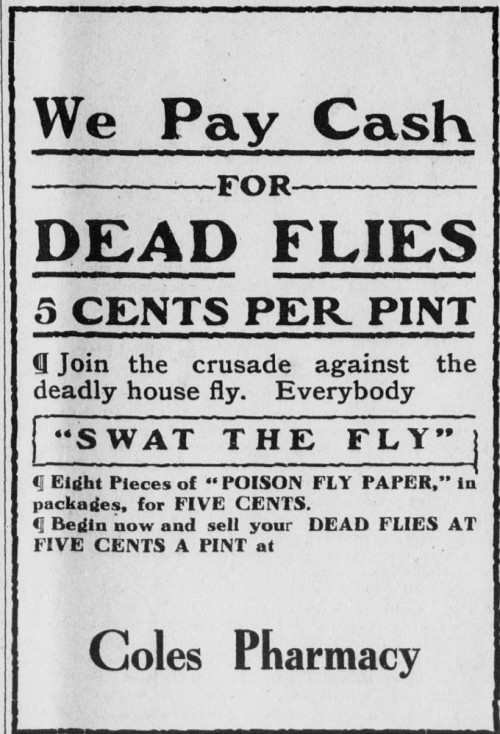
From the Mansfield Advertiser, Mansfield, Penn., June 24, 1914, via Centuries of Advice and Advertisements.
Selasa, 25 Januari 2011
Mumblety-peg

The term "Mumblety-peg" came from the practice of putting a peg of about 2 or 3 inches into the ground. The loser of the game had to take it out with his teeth. Mumbletypeg was very popular as a schoolyard game in the nineteenth and first half of the twentieth centuries, but with increased concern over child safety the game has declined in popularity...Photo reproduction of 1922 magazine page via Centuries of Advice & Advertisement.
Mumblety peg is generally played between two people with the aid of a pocket knife. In one version of the game, two opponents stand opposite one another with their feet shoulder-width apart. The first player then takes the knife and throws it to "stick" in the ground as near his own foot as possible. The second player then repeats the process. Whichever player "sticks" the knife closest to his own foot wins the game.
If a player "sticks" the knife in his own foot, he wins the game by default...
Addendum: Rules here, courtesy of Doc Rock.
Sabtu, 22 Januari 2011
A history of disinfected mail

A very informative philatelic exhibit presents examples of how the U.S. has dealth with potentially dangerous items. Shown at the top, for example, are two letters from locations where yellow fever was present; they have been punctured to allow fumigating agents to reach the inside of the envelope. The bottom envelope in this image -

These precautions were not limited to the preantibiotic era. In 2001 threats of anthrax attacks were made in the United States, and a variety of special precautions, including x-irradiation, had to be undertaken, beginning at this page of the exhibit and continuing for a dozen pages thereafter. And these letters from Hawaii in 1900 show how holes were punched in the envelopes -

Philatelic exhibitions are conventionally mounted on a series of glass-fronted frames, with up to 16 letter-size pages in one frame, and in this case spread onto six frames. This award-winning exhibit was created by William A. Sandrik of Arlington, Virginia. The entire exhibit may be viewed at Exponet (frame 1, frame 2, frame 3, frame 4, frame 5, frame 6).
And those interested in philately (stamp and postal history collecting) should browse the Exponet site beginning at this index page. Over 600 exhibits are accessible, on a huge variety of topics, in a wide variety of languages.
Langganan:
Postingan (Atom)