Amateur photographer Ingrid Bunse snapped this photograph of a waterbuck with lop-sided horns while on safari in the Ongava Wilderness Reserve, Namibia. She said: "When I spotted this animal I knew I had to get a picture because it was so unusual - I've never seen anything like it. I don't know what caused the horn to curl like this but it didn't seem to be too bothered by it."It must have been that way a long time, judging by the way the tip of the horn has been burnished during grazing.
Tampilkan postingan dengan label curiosities. Tampilkan semua postingan
Selasa, 08 Maret 2011
Lopsided waterbuck
From The Telegraph:
Old Leatherman
BoingBoing this week linked to a story in the New York Times about "Leather Man" - a vagabond who walked the roads of western Connecticut in the late 19th century. That reminded me of a link I've saved from last year, in the Housatonic Times, recounting his story:
From 1856 to about 1882, he roamed the countryside until he began a now-famous clockwise circuit of 365 miles every 34 days, a route he followed for about seven years until his death in 1889...The modern controversy centers around whether his body should be exhumed from its current mislabeled pauper's grave, subjected to forensic testing, and relocated to a different site. You can read about that at the NYT or BoingBoing.
“What we do know is that as people got to know him, they feared him less and less and opened their homes to the Leatherman. It became an honor to feed him. People would miss church socials if they knew he was going to come through town, and these weren’t just ordinary townsfolk. Pretty prominent people helped him as well.”
Ms. Sutton said tanneries often left good scrap leather out for the Leatherman to use in repairing his suit, while townspeople left out food, tobacco and even money...
He was referred to as old, Ms. Sutton speculates, due to his grimy appearance and depressed demeanor. His clothing was pieced together out of small pieces of leather, stitched with wider strips of leather, which was worn over woolen underclothes...
Senin, 07 Maret 2011
Here's a One-and-two-thirds-dollar bill
I found it in the collections of the National Museum of American History at the Smithsonian. The photos are of marginal quality, but are supplemented by this description:
The note is worn, and, in common with several of its fellows, it was carefully stitched together, obscuring part of the design. But if we could see everything, we would see that, on the front of the note, a figure representing Great Britain receives a petition of the Continental Congress. It is handed to her by an America, who is simultaneously trampling on a scroll marked SLAVERY and holding aloft a Liberty cap on a pole, a beacon for American troops who are hastening to the scene from the right.That explains the design, but not the curious denomination. There were no American "dollars" until 1792, so the dollar referenced in this bill would have been the Spanish one. But why have the bill in such an odd multiple? Any numismatists out there have ideas?
Meanwhile, George III (the figure at the center-left) is doing his best to set fire to an American city (perhaps Baltimore) already under attack from a British fleet. He's also trampling a copy of Magna Charta, just to underscore the point. Inscriptions along the sides read "AN APPEAL TO HEAVEN" and "PRO ARIS ET FOCIS" (For altars and hearths). The other side of the note conveys hope. Britain and America are shown achieving peace, with the reminder that "PAX TRIUMPHIS POTIOR" (Peace is preferable to victory).
The note was designed by Annapolis silversmith Thomas Sparrow in the summer of 1775. His initials are inscribed on the front and his full name on the back. This series of Maryland notes remains the most politically charged currency ever issued in the United States during wartime.
Minggu, 06 Maret 2011
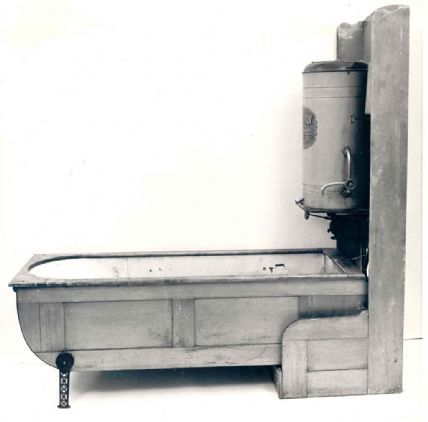
Three folding bathtubs
From the National Museum of American History at the Smithsonian:
Via Historical Indulgences.
Addendum: Stella remembered having seen one on Antiques Roadshow years ago, so I tracked it down at PBS:
Valued at $3,500. And the search also led me to Tiny House Blog, which has photos that better illustrate the color of the woodwork and its appearance when closed:
The Mosely Folding Bath Company advertised a folding bath in the 1895 Montgomery Ward Catalog. This tub, disguised as a mirrored wardrobe, folded down and out of its wood casing into the room, revealing the heater above.The bathtub was not connected to drainage plumbing, so it had to be scooped out after use.
Via Historical Indulgences.
Addendum: Stella remembered having seen one on Antiques Roadshow years ago, so I tracked it down at PBS:
Valued at $3,500. And the search also led me to Tiny House Blog, which has photos that better illustrate the color of the woodwork and its appearance when closed:
Kamis, 03 Maret 2011
"Ear buckets"
Curious as to whether these ornaments served a utilitarian purpose, I tracked down the illustration to p. 133 of Man and Beast in Eastern Ethiopia (1911), but couldn't find any textual commentary.
Via Uncertain Times.
"Round ice"


Posted in 2008:
The two photos above are part of a set posted in the often-interesting English Russia website. They depict a large round slab of ice floating on water, surrounded by a flotilla of smaller ones. No explanation is offered for their creation.
It appears to me that these formations are occurring in a river (lower picture above and some of the others seem to show flowing water adjacent to the ice floes). If so, I suspect these form when floating ice reaches an eddy in the river, and the rotation of the water grinds the edges of the floes until they become circular.
Update 2011:
Futility Closet has posted an image of a similar phenomenon recorded in New York State in the 19th century:
"There is a curious ice formation on the Mianus River, near the village of Bedford, Westchester County, New York. The Mianus at that place is a small stream, averaging about ten feet in width. At a place locally known as the ‘ten foot hole’ the stream widens out into a pool forty or fifty feet wide. In this pool there has formed a cake of ice about twenty five or thirty feet in diameter and perfectly circular in shape. This circular cake of ice is slowly revolving and is surrounded for about two-thirds of its circumference by stationary ice. There is a space of about three inches between the revolving cake and the stationary ice, except at the ‘up stream’ side of the revolving cake, where the water is open and the current quite swift. Each revolution takes about six minutes..."
There's also a photo here of a huge one in Canada, and a video of one in Canada.
Senin, 28 Februari 2011
How can you tell if an orange is ripe?
According to the staff at QI, you can't go by its color:
You can’t tell the ripeness of an orange by its colour, no matter where it’s from. If an orange is unpicked, it can stay on the tree until the next season, during which time fluctuations in temperature can make it turn from green to orange and back to green again without the quality or flavour being affected.Another interesting fact is that Alexander the Great artificially colored his hair:
Alexander the Great washed his hair in saffron to keep it a lovely shiny orange colour. During his time saffron was as rare as diamonds and more expensive than gold.
Jumat, 25 Februari 2011
How to make a "skull cup" dining utensil
The process is explained in this BBC video in conjunction with a new report that ancient Britons drank from carefully crafted human skulls.
Found at Gadling, which added this photo (credit) of an elaborately carved Chinese skull cup:
Via BoingBoing.
Rabu, 23 Februari 2011
Did an ancient Roman invent "flexible glass" ?
From an interesting post this week at Beachcombing's Bizarre History Blog:
If you have any ideas, please insert them in the comments here, or at the original link.
The story appears first in Petronius’ Satyricon (51 – early first century AD): ‘However, there was an artificer once who made a glass goblet that would not break. So he was admitted to the Emperor’s presence to offer him his invention; then, on receiving the cup back from the Emperor’s hands, he dashed it down on the floor. Who so startled as the Emperor? But the man quietly picked up the goblet again, which was dinted as a vessel of bronze might be. Then taking a little hammer from his pocket, he easily and neatly knocked the goblet into shape again. This done, the fellow thought he was as good as in heaven already, especially when Emperor said to him, ‘Does anybody else besides yourself understand the manufacture of this glass?’ But, on his replying in the negative, Emperor ordered him to be beheaded, because if once the secret became known, we should think no more of gold than of so much dirt.’Beachcombing notes that the story was retold two centuries later, and a different incident was reported in 79 AD:
Pliny the Elder (obit 79 AD), a near contemporary, reports that in the time of Tiberius, forty years before he brought out his Natural History, a new kind of flexible glass was produced that the Emperor did everything possible to outlaw, even destroying the workshop of the inventor (‘totam officinam artificis eius abolitam’).Fable/myth? Or true? There's a discussion at the link, with a addendum suggesting that the Romans might have invented tempered glass. A different possibility that occurred to me is that a craftsman could have acquired a large lump of relatively clear amber (does amber come in clear form?) and worked into the shape of a glass (? is that possible).
If you have any ideas, please insert them in the comments here, or at the original link.
Jeopardy! trivia
I watched the Jeopardy! match featuring Watson vs humans, and was decidedly "underwhelmed." The programs seemed to be structured mostly as an advertisement for IBM's prowess. But the event has triggered some interesting articles on the web, including an assortment of interesting trivia posted at Slate. Here, for example, are the most commonly used Jeopardy! categories:
TYWKIWDBI doesn't have a category in the sidebar for "before and after," but we've got most of the other ones covered. Here are some other interesting tidbits:
What's the most common answer on Jeopardy? That would be "What is Australia?" That response appears 208 times. In fact, thanks to the prominence of geography-related categories, the Top 23 answers are all places. (Click here for a list.) At No. 24: George Washington.There's more at the link.
...where's the best place on the board to find a Daily Double? Far from being randomly distributed, Daily Doubles are heavily concentrated at the bottom of the board. Of the roughly 10,000 such clues logged on J-Archive, 92 percent were in the bottom three (of five) rows. In fact, only two Daily Doubles in the archive ever appeared in the top-left corner, once in 1999 and then in 2003. The cell densest with Daily Doubles? Fourth from the top, far left—home to 834 of them, or 8 percent of the total.
As players descend the gameboard's rows, the clues get harder: 96 percent of clues in the top row are solved, 91 percent in the second row, 86 percent in the third row, 80 percent in the fourth row, and just 71 percent in the bottom row.
Selasa, 22 Februari 2011
Snowballs spending a day at the beach
"It happens when there's a heavy snowfall and some wind at a time when the water is cold enough to freeze but due to motion it is prevented from doing so.From foamymilkyway, where there are additional photos of this phenomenon.
Conditions must be: Water temperature at zero deg. C., snow falling into the waves and combining together as the waves roll it along; think of it rolling a snowball on a liquid surface rather than a field, I'm sure you get the idea.
In Cape Breton this phenomenon is known by local fishermen as "a Lolly".
Minggu, 20 Februari 2011
"Bownessie", the English Loch Ness monster
The Telegraph and a variety of other news sources have reported the sighting of a mysterious object in Lake Windemere, consistent with the legendary creature of that lake.
The photograph, which shows an object with three humps breaching the surface of the lake, is said to be the best evidence yet of what some claim is a monster... It was taken on a camera phone by Tom Pickles, 24, while kayaking on the lake as part of a team building exercise with his IT company, CapGemini, last Friday.More details at the link, but more interesting is that a search for more information on "Bownessie" led me to a "List of reported lake monsters." There must be almost a hundred there, from Canada and the U.S., Africa, Asia, Europe, Australia. And so many unusual names: Ogopogo, Cressie, Mussie, Mokele-mbembe, Muc-sheilch, Lagarfljots Worm, Brosno Dragon. Lots of links for cryptid enthusiasts to explore.
Mr Pickles said he saw an animal the size of three cars speed past him on the lake and watched it for about 20 seconds. He said: “It was petrifying and we paddled back to the shore straight away. At first I thought it was a dog and then saw it was much bigger and moving really quickly at about 10mph. “Each hump was moving in a rippling motion and it was swimming fast. Its skin was like a seal’s but it’s shape was completely abnormal – it’s not like any animal I’ve ever seen before."
This is believed to be the eighth sighting of a long humpbacked creature – known by local residents as "Bownessie" – in the past last five years.
Kamis, 10 Februari 2011
Can a moose be used as a "beast of burden" ??
I saw the photo above at Uncertain Times and began to wonder. One's knee-jerk reaction is, of course, to assume that every odd photo is 'shopped, but reindeer have been semi-domesticated for centuries. Could you train a moose to pull loads, if you started at an early age?
I couldn't track down that photo's original source, but I did find these images of young moose in harness at Black Bear Blog:
The first shows a young moose harnessed to a carriage; it comes from Alaska History Store and is labeled "Skagway Alaska." The second moose seems to pulling either a travois or a plough. One comment at the Black Bear Blog linked to this photo -
- showing "a pair of moose, hand-raised by owner Peachy Prouden. The photo was taken at Athabasca Landing, Alberta in 1898."
Here's one more, from Tossing Pebbles in the Stream:
- where there is also a photo of a moose with a saddle on it.
So, now that we're convinced that a "working moose" is possible, what about the original photo? It is Photoshopped, as explained at this "urban legends" site, where note is made of "Chevaux d'Abitibi" ("Horses of Abitibi") on the man's jacket and the mirror-image woodpiles on the left and right covering some other item(s) in the original photo.
But it is possible.
And, if you've read this far and are still paying attention, you might move on to this Google Books link that explains why a moose's long legs give it an advantage in fleeing from wolves on irregular terrain (and other quite interesting biologic tidbits).
Addendum: An anonymous commenter has found a somewhat-over-the-top video of a pet moose:
Personally, I like this one better:
Second addendum: Reader Spiritartartist found and posted this photo of a (quite large) moose in harness in her blog three years ago:
The moose was named "February," and the photo was taken in New Jersey in 1886; details at the link.
I couldn't track down that photo's original source, but I did find these images of young moose in harness at Black Bear Blog:
The first shows a young moose harnessed to a carriage; it comes from Alaska History Store and is labeled "Skagway Alaska." The second moose seems to pulling either a travois or a plough. One comment at the Black Bear Blog linked to this photo -
- showing "a pair of moose, hand-raised by owner Peachy Prouden. The photo was taken at Athabasca Landing, Alberta in 1898."
Here's one more, from Tossing Pebbles in the Stream:
- where there is also a photo of a moose with a saddle on it.
So, now that we're convinced that a "working moose" is possible, what about the original photo? It is Photoshopped, as explained at this "urban legends" site, where note is made of "Chevaux d'Abitibi" ("Horses of Abitibi") on the man's jacket and the mirror-image woodpiles on the left and right covering some other item(s) in the original photo.
But it is possible.
And, if you've read this far and are still paying attention, you might move on to this Google Books link that explains why a moose's long legs give it an advantage in fleeing from wolves on irregular terrain (and other quite interesting biologic tidbits).
Addendum: An anonymous commenter has found a somewhat-over-the-top video of a pet moose:
Personally, I like this one better:
Second addendum: Reader Spiritartartist found and posted this photo of a (quite large) moose in harness in her blog three years ago:
The moose was named "February," and the photo was taken in New Jersey in 1886; details at the link.
Selasa, 08 Februari 2011
Cyclops
In Greek mythology and later Roman mythology, a cyclops was a member of a primordial race of giants, each with a single eye in the middle of its forehead. The classical plural is cyclopes [you learn something every day...]. The name is widely thought to mean "circle-eyed".There is another possible origin of the legend:
Given their penchant for blacksmithing, many scholars believe the legend of the Cyclopes' single eye arose from an actual practice of blacksmiths wearing an eyepatch over one eye to prevent flying sparks from blinding them in both eyes...
...prehistoric dwarf elephant skulls – about twice the size of a human skull – that may have been found by the Greeks on Crete and Sicily... the large, central nasal cavity (for the trunk) in the skull might have been interpreted as a large single eye-socket. Given the inexperience of the locals with living elephants, they were unlikely to recognize the skull for what it actually was...Text from Wikipedia. The image is "Marcel Marien, L'introuvable, 1937. Glass, acrylic glass, 11 x 27 x 18 cm. Coll. Sylvio Perlstein, Antwerp © VG Bild-Kunst, Bonn 2010," posted at ArtDaily as an example of a surreal art object. Via Uncertain Times.
Minggu, 30 Januari 2011
Jodhpur
Why the population of the fortress city – the Blue City as it is universally known – took to painting their houses in various shades of blue is not completely certain. Yet most believe it is to do with the prevailing caste system in India.From an interesting post with several dozen photos at Kuriositas,
Buenos Aires
Interesting street pattern. Photo found at Consciousness is a Congenital Hallucination.
Sabtu, 29 Januari 2011
Carnivorous pitcher plants provide homes for bats
From another interesting piece at Ed Yong's Not Exactly Rocket Science column at Discover:
The world’s worst [?] flesh-eating plant lives in the jungles of Borneo. It’s called elongata and it’s one of several strains of Raffles’ pitcher plant. Like its relatives, it has distinctive pitcher-shaped leaves that can lure insects into a watery grave. But unlike other strains, elongata is strangely incompetent at catching insects. Instead, it lures bats into its pitchers, and lives off their poo...
Elongata looks much like other pitcher plants, except for its giant traps. They’re around four times larger than those of its relatives, they don’t contain much fluid, and they don’t emit any noticeable smell. At such a size, you’d expect the pitchers to be swimming in insects. But when Ulmar Grafe from the University of Brunei Darussalam looked inside the giant pitchers, he found six to seven times fewer insects than in other pitchers. Instead, he found small bats...
In the pitchers, the bats get shelter from predators and the elements. But what does the plant get in return for providing a living bat-cave? In a word: faeces. The bats defecate into the pitchers, providing the plant with at least a third of its nitrogen, packaged in neat dollops.
"Blowtorch" - a mechanical horse
Blowtorch, a life size mechanical horse, was the pet project and creation of W.J. McIntyre, a Swift Current, Saskatchewan inventor... Blowtorch’s body was fashioned from sheet metal. A nine hp gasoline engine provided the “horsepower.” Small wheels were hidden under his hooves. The legs slid back and forth. A foot throttle controlled the speed; a brake cable slowed it down... McIntyre rode his mechanical steed at local fairs where its peculiar lurching gait delighted the crowds.The rest of the story is at the Saskatchewan Western Development Museum web page. Posted for Funder and her readers (someone obviously thought a mechanical horse was a good idea at the time...)
After McIntyre’s death in 1965, Blowtorch was put out to pasture. Neglected and almost forgotten, the elements took their toll... That’s when Allan Jacobs, a welder at McIntyre’s shop, spotted the tired horse and decided to do something about it...
On a $20 dare by Jim, Jacobs headed for the fairgrounds astride Blowtorch in the 1968 Swift Current parade. However, disaster struck when the horse’s tiny wheels got stuck in an expansion joint on an overpass. The jolt was more than Blowtorch could take and the poor horse lost his head. Jacobs managed somehow to put the head back on, holding it in place with the halter and bridle. But things did not go well for long. As they turned a corner, Blowtorch snapped a leg bolt, and down went horse and rider. Jacobs, dressed as a cowboy, pulled out his toy gun and “shot” the crippled horse as the crowd roared its approval.
But this was not the end of Blowtorch...
Via Nothing to do with Arbroath.
Stop
When I saw the image above in a photoessay about the Ukraine, I was immediately reminded of this comment by Bill Bryson, in his book The Mother Tongue; English and how it got that way -
Addendum: Andrew and Fletcher indicate Portugal and Spain use the word "Stop" on their signs. And ch.zimmerman found a Wikipedia page on this topic - with interesting photos of Stop signs in many countries.
“In Yugoslavia they speak five languages. In not one of them does the word stop exist, yet every stop sign in the country says just that.” (p. 179)I wonder if other countries also use the word "Stop" on signs, but not in the native language.
Addendum: Andrew and Fletcher indicate Portugal and Spain use the word "Stop" on their signs. And ch.zimmerman found a Wikipedia page on this topic - with interesting photos of Stop signs in many countries.
Selasa, 25 Januari 2011
A mourning buckle
An interesting item from the Victoria and Albert:
I couldn't find a way to rotate the photo 90 degrees to orient it more "buckle-like," so it looks a bit odd. The hair runs around the perimeter of the buckle, underneath the inscription.
Image fixed, with a hat tip to nolandda!
Jewels commemorating the dead were widely worn during the 17th century. This mourning buckle contains panels of woven hair, decorated with an elaborate inscription in gold thread and a small enamelled skull, all set behind rock crystal. The inscription, partly in Latin, tells us that the piece commemorates Elizabeth Harman who died on 11 April 1698, aged 27.
Image fixed, with a hat tip to nolandda!
Langganan:
Postingan (Atom)