Amateur photographer Ingrid Bunse snapped this photograph of a waterbuck with lop-sided horns while on safari in the Ongava Wilderness Reserve, Namibia. She said: "When I spotted this animal I knew I had to get a picture because it was so unusual - I've never seen anything like it. I don't know what caused the horn to curl like this but it didn't seem to be too bothered by it."It must have been that way a long time, judging by the way the tip of the horn has been burnished during grazing.
Tampilkan postingan dengan label nature. Tampilkan semua postingan
Selasa, 08 Maret 2011
Lopsided waterbuck
From The Telegraph:
Senin, 07 Maret 2011
Ajolote (Mexican mole lizard)
Properly termed bipes biporus, but known as the "five-toed worm lizard" to his friends, this little critter is nicely described at Scrubmuncher's Blog:
It really does look like a pink nightcrawler with forelegs.
Fossorial and seldom seen, precious little is known about the biology of the 160 or so described species of worm lizard. Almost all of them live in the tropics or sub-tropics and it is their admirable adaptations for a subterranean existence that really single them out. Along with their limbs they have all but lost their eyes and they retain just the vestiges of these organs – tiny, beady and covered with a thin scale...More at the link, which also has a video showing the ajolote trying to burrow into loose soil. And at H.E.R.P. I found this photo, which gives a better size indication.
Worm lizards make their tunnels by using their head like a battering ram, a rather brutal, yet effective technique necessitating a heavily reinforced skull where there individual bones of skull are all fused. Some species have a spade-shaped head, which is used to compress the soil into the top of the tunnel, while other species have a keel shaped head they use to press the soil in to the sides of the tunnel by vigorously moving their head from side to side...
In Latin, Amphisbaena means to ‘move in both ways’ reflecting the animal’s ability to move forwards and backwards equally well. Also, in myth and legend the amphisbaena was a fabulous beast with a head at either end of its body, perhaps the brainchild of a medieval chronicler who saw a worm lizard in its defensive posture...
It really does look like a pink nightcrawler with forelegs.
Minggu, 06 Maret 2011
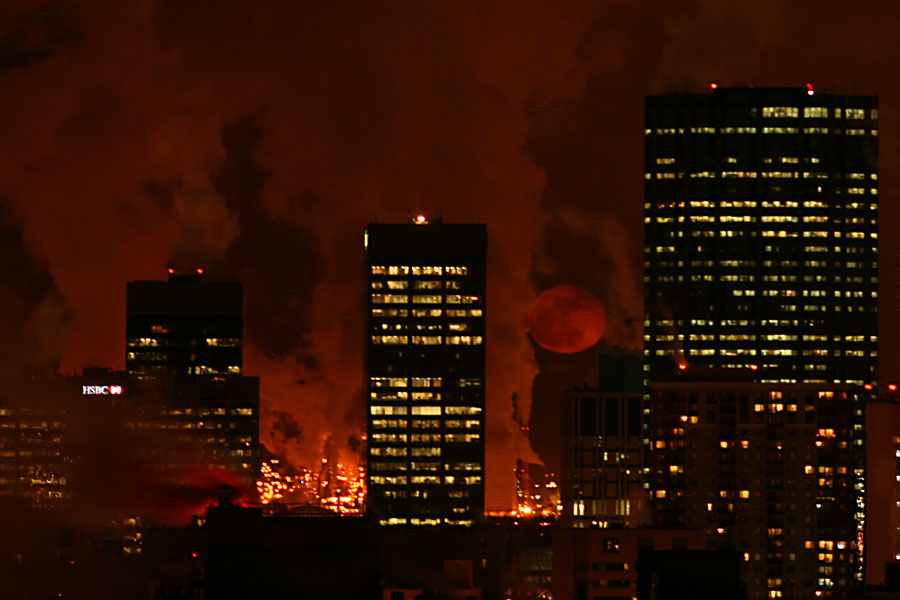
How many full moons can you name ?
From January to December, the order is wolf moon, snow moon, worm moon, pink moon, flower moon, strawberry moon, buck moon, sturgeon moon, corn moon, harvest moon, beaver moon, and cold moon.
They are all explained at the Farmers' Almanac. The one in the embedded APOD photo is a red "snow moon" over Edmonton.
Kamis, 03 Maret 2011
"Round ice"


Posted in 2008:
The two photos above are part of a set posted in the often-interesting English Russia website. They depict a large round slab of ice floating on water, surrounded by a flotilla of smaller ones. No explanation is offered for their creation.
It appears to me that these formations are occurring in a river (lower picture above and some of the others seem to show flowing water adjacent to the ice floes). If so, I suspect these form when floating ice reaches an eddy in the river, and the rotation of the water grinds the edges of the floes until they become circular.
Update 2011:
Futility Closet has posted an image of a similar phenomenon recorded in New York State in the 19th century:
"There is a curious ice formation on the Mianus River, near the village of Bedford, Westchester County, New York. The Mianus at that place is a small stream, averaging about ten feet in width. At a place locally known as the ‘ten foot hole’ the stream widens out into a pool forty or fifty feet wide. In this pool there has formed a cake of ice about twenty five or thirty feet in diameter and perfectly circular in shape. This circular cake of ice is slowly revolving and is surrounded for about two-thirds of its circumference by stationary ice. There is a space of about three inches between the revolving cake and the stationary ice, except at the ‘up stream’ side of the revolving cake, where the water is open and the current quite swift. Each revolution takes about six minutes..."
There's also a photo here of a huge one in Canada, and a video of one in Canada.
Rabu, 02 Maret 2011
Smithsonian photography contest
Credit: Charles Littlewood (Silver Springs, Florida). Photographed June 2009, Micanopy, Florida.
It also means you can begin entering your own photos into the 9th Annual contest.
Sabtu, 26 Februari 2011
Traveller's palm
What a magnificent plant (Philippine Islands, 1926). Details from Wikipedia:
Ravenala madagascariensis, commonly known as Traveller's Tree or Traveller's Palm, is a species of plant from Madagascar. It is not a true palm (family Arecaceae) but a member of the bird-of-paradise family, Strelitziaceae... It has been given the name "traveller's palm" because the sheaths of the stems hold rainwater, which can be used as an emergency drinking supply. The enormous paddle-shaped leaves are borne on long petioles, in a distinctive fan shape aligned in a single plane.Photo from the NOAA Library, via the New Shelton wet/dry.
Beachcombing results
Seashells, snails and other beach treasures found on remote islands of the Sea of Cortez, Mexico. (arranged by hand).
Verena Popp-Hackner and Georg Popp.
Source, via First Time User.
"Nature, red in tooth and claw with ravine..."
Tennyson's full quote goes as follows:
Photo: Nathan Myhrvold, from The Third Culture.
Man...- from a group of cantos entitled, "In Memorium A.H.H." (1850). (source)
Who trusted God was love indeed
And love Creation's final law --
Tho' Nature, red in tooth and claw
With ravine, shrieked against his creed.
Photo: Nathan Myhrvold, from The Third Culture.
Rabu, 23 Februari 2011
Post-earthquake iceberg
A group of people travel with Glacier Explorers to see one of the many icebergs that caved into Tasman Lake as a result of the 6.3 earthquake in Christchurch, New Zealand, Tuesday, February 22, 2011. (AP Photo/NZPA, Denis Callesen)
A beautiful image from a set of 50+ photos of the aftermath of the Christchurch earthquake, posted at The Atlantic's new In Focus photoessay feature. (The caption of the photo must have a typo; I'm sure they meant to say that "many icebergs calved" into Tasman Lake.)
Selasa, 22 Februari 2011
Snowballs spending a day at the beach
"It happens when there's a heavy snowfall and some wind at a time when the water is cold enough to freeze but due to motion it is prevented from doing so.From foamymilkyway, where there are additional photos of this phenomenon.
Conditions must be: Water temperature at zero deg. C., snow falling into the waves and combining together as the waves roll it along; think of it rolling a snowball on a liquid surface rather than a field, I'm sure you get the idea.
In Cape Breton this phenomenon is known by local fishermen as "a Lolly".
Senin, 21 Februari 2011
Sea coal
[Chalk drawing, 'Sea Coal Gatherers' by Frederic Shields, undated]
This past week I encountered the drawing above at Victorian/Edwardian Paintings. My personal experiences with coal began when I lived for a time in a semi-rural location in Kentucky and heated my house with a coal-burning stove. I was surprised at the time to note how relatively light in weight coal was, but I had never thought much about it floating in water until I saw this drawing.
A quick search led me to Within the Walled Garden, which had a story about harvesting the material along a beach:
We followed the high tide line because I love to search for treasures. Coloured or shiny bits glinting in their recent wetness. A woman in front had a dog and a bag of stuff she kept gleaning from the berm ahead of us. I asked her what she was scavenging. "Sea coal" she said, and showed us how to identify the lumps and distinguish them from the black pebbles by their lighter weight and glimmer even when dry... It wasn't a great harvest because we only had DJ's hat to carry it in. But we shall return.The post included this photo of freshly acquired sea coal -
- showing the rounded edges consistent with wave action, quite different from the material available in Kentucky roadcuts.
The next useful item I found was "A Manxman's Tale", about sea coal scavenging, in The British Journal of Photography:
Killip first visited the beaches around Lynemouth in 1975 but, he says, it took him years to win the sea coalers' trust. 'I went there when I was first in Newcastle, and I couldn't believe it,' he remembers. 'It was so odd, these guys getting coal from the sea, and so visually amazing with all these horses and carts. But when I went on the beach with my camera, they just turned around and tried to run me down. I pulled off the beach and didn't go back for two years. When I did, the same thing happened. This continued until 1981, when I had a very bad afternoon and decided to go to the sea coalers' local to reason with them. They said "Listen, we get photographed by the dole. They sit in the van and they spy on us, and then when we go to get welfare they produce these photographs and we won't get any money. For us photographs are bad news, and we don't want any."The final question I had was whether sea coal was a purely natural phenomenon, from exposed veins on seashores, or whether it was somehow a byproduct of the transportation of coal in barges or other vessels. The answer came from this Wikipedia entry about Cresswell, Northumberland:
Snab Point, 500 metres south of The Carrs, is a sheltered bay with the Alcan aluminium smelting plant on its south side. Embedded in the small cliffs of Snab Point are the remnants of fossilised trees. The beach area is littered with the remnants of fossilised wood and small seams of coal can be seen in the cliffs. Depending on the tides and wind, vast swathes of sea coal is washed up within the bay.A photo at the link shows a beach strewn with sea coal. There's more on the history of sea coal at The Public "I":
“In the last four decades of the thirteenth century, the cost of wood increased about 70 percent, while sea coal increased only 23 percent… Londoners had no choice but to resort to sea coal, which was rapidly becoming known simply as "coal." By 1300, London's total annual wood fuel demand was 70,000 acres. By 1400, it was only 44,000, despite prodigious industrial, commercial and population growth.” The street in London where merchants sold their cargos still bears the name “Seacoal Lane”...The Durham County Council has this probably Victorian-era photo of the gathering of sea coal:
and the BBC shows the modern equivalent:
Sadly, this photo from the Science Photo Library is also relevant:
"...coal waste being dumped into the North Sea from Easington Colliery, County Durham (background). In the foreground is a discharge pipe emptying effluent from the mines into the sea. The sea is discoloured for several miles around the dump and the beaches are black with coal waste."You learn something every day.
Aeroecology
From the BBC:
Meteorologists once treated the signals from flying animals as a nuisance that complicated their measurements. But recent improvements in computing power and networking of radar stations have turned that nuisance signal into a valuable data source on animal ecology.See also: Mayflies seen on radar.
A panel told the AAAS conference that radar could spot a single bee at 50km...
"One of the things that's most exciting to me is that we sometimes see an airmass that's moving, like a weather front, and insects actually get trapped up in that - you can see the insects pooling up along this air mass. If this happens to pass over the bat caves at sunset, the bats come out and distribute themselves right along that gust front and presumably gobble up those insects. Marine biologists probably think that kind of thing happens all the time in the ocean, but we've never been able to see that in the aerosphere."
Sabtu, 19 Februari 2011
A komondor
A Komondorak in the ring during the 135th Westminster Kennel Club Dog Show at Madison Square Garden.
(Timothy A. Clary/AFP/Getty Images) (source)
Selected interesting information from Wikipedia:
The Komondor (Hungarian plural komondorok) is a large white-colored Hungarian breed of livestock guardian dog with a long, corded coat. They are sometimes referred to as mop dogs. The Komondor is an old-established powerful dog breed which has a natural guardian instinct to guard livestock and other property. The Komondor was mentioned for the first time in 1544 in a Hungarian codex. The Komondor breed has been declared one of Hungary’s national treasures, to be preserved and protected from modification...
The Komondor is built for livestock guarding... the coat of the dog looks similar to that of a sheep so it can easily blend into a flock and camouflage itself giving it an advantage when predators such as wolves attack...
A fully mature coat is formed naturally from the soft undercoat and the coarser outer coat combining to form tassels, or cords and will take around two years to form. Some help is needed in separating the cords so the dog does not turn into one large matted mess... Traditionally the coat protected the Komondor from wolves' bites, as the bites were not able to penetrate the thick coat. The coat of the Komondor takes about two and a half days to dry after a bath...
Another rainbow-colored bird
Beautiful, but not identified by species at Pixdaus. I've posted the rainbow finch and the rainbow lorikeet before. Is this the latter?
Addendum: answered within 5 minutes by Blitherypoop: it's a black-masked lovebird (Agapornis personata).
Second addendum: photo credit Chris Gin (taken at the Auckland Zoo).
Addendum: answered within 5 minutes by Blitherypoop: it's a black-masked lovebird (Agapornis personata).
Second addendum: photo credit Chris Gin (taken at the Auckland Zoo).
Jumat, 18 Februari 2011
Brazilian sand dunes
In a land still soaked from the rainy season, a river stained with tannin from a nearby forest marbles the sand.
From a set of ten photos at National Geographic, via La Muse Verte. I have previously written a post about the remarkable Lençóis Maranhenses National Park.
Selasa, 15 Februari 2011
How many species of dogs are there ?
I think most people would be quite surprised by the answer, which I found at the QI column at The Telegraph.
And are there more species of dogs than horses? A yes-or-no answer is sufficient here.
Before you click the link, do your best to come up with answers on your own. I will also post the answer in the Comments in case the source undergoes linkrot.
You learn something every day.
And are there more species of dogs than horses? A yes-or-no answer is sufficient here.
Before you click the link, do your best to come up with answers on your own. I will also post the answer in the Comments in case the source undergoes linkrot.
You learn something every day.
Kamis, 10 Februari 2011
Bioluminescence
The photos above were taken at the Gippsland Lakes (Victoria, Australia), where in 2007 fires and floods resulted in massive amounts of nitrogen being washed into the lakes, which resulted in an algal bloom...
Massive blooms of bioluminescent organisms can produce "milky seas" that can be seen from satellites, as shown in this image from Chemical and Engineering News:
But this was not the blue-green algae that had appeared in the lakes before. Early analysis identified the cause of the green tinge as an algal outbreak of Synechococcus... As summer took hold at the end of 2008, what happened surprised everyone – a new species called Noctiluca Scintillans began to prosper, by feeding on the Synechococcus.You can read the rest of the story at Phil Hart's webpage and see additional photos in his gallery (via Neatorama).
In contrast to the widespread bright green of the Synechococcus, Noctiluca Scintillans was visible during the day as localised murky red patches, often building up on sections of shoreline facing the wind during the day. At night though, Noctiluca Scintillans produced a remarkable form of bioluminescence (popularly referred to as ‘phosphorescence’) – the water glowing brightly wherever there was movement – in the waves breaking on the shore, in ripples in the water and wherever people played in the water.
Massive blooms of bioluminescent organisms can produce "milky seas" that can be seen from satellites, as shown in this image from Chemical and Engineering News:
"Generated most likely by the bacterium Vibrio harveyi, this awesome display of flamboyant biological chemistry happened on a vast scale: The researchers estimate that it took a bloom of 40 billion trillion (4 X 10²²) bioluminescent cells to generate the milky sea that the Lima had encountered."
The spider and the snail shell
BBC videos often cannot be embedded, so those interested will need to go to the link to view a fascinating two-minute segment narrated by David Attenborough. The Olios coenobitus spider in Madagascar prefers to live inside empty snail shells; for additional protection, the spider uses its silk to pull the empty shell up in the air.
The spiders made significant effort to avoid predators, hauling shells up to 20 times their own weight for over half an hour. "Just hiding in a shell on the ground would expose the spider to heat and ants, which are voracious predators of the desert ecosystem," said Mr Fiely.Via Oregon Expat.
Can a moose be used as a "beast of burden" ??
I saw the photo above at Uncertain Times and began to wonder. One's knee-jerk reaction is, of course, to assume that every odd photo is 'shopped, but reindeer have been semi-domesticated for centuries. Could you train a moose to pull loads, if you started at an early age?
I couldn't track down that photo's original source, but I did find these images of young moose in harness at Black Bear Blog:
The first shows a young moose harnessed to a carriage; it comes from Alaska History Store and is labeled "Skagway Alaska." The second moose seems to pulling either a travois or a plough. One comment at the Black Bear Blog linked to this photo -
- showing "a pair of moose, hand-raised by owner Peachy Prouden. The photo was taken at Athabasca Landing, Alberta in 1898."
Here's one more, from Tossing Pebbles in the Stream:
- where there is also a photo of a moose with a saddle on it.
So, now that we're convinced that a "working moose" is possible, what about the original photo? It is Photoshopped, as explained at this "urban legends" site, where note is made of "Chevaux d'Abitibi" ("Horses of Abitibi") on the man's jacket and the mirror-image woodpiles on the left and right covering some other item(s) in the original photo.
But it is possible.
And, if you've read this far and are still paying attention, you might move on to this Google Books link that explains why a moose's long legs give it an advantage in fleeing from wolves on irregular terrain (and other quite interesting biologic tidbits).
Addendum: An anonymous commenter has found a somewhat-over-the-top video of a pet moose:
Personally, I like this one better:
Second addendum: Reader Spiritartartist found and posted this photo of a (quite large) moose in harness in her blog three years ago:
The moose was named "February," and the photo was taken in New Jersey in 1886; details at the link.
I couldn't track down that photo's original source, but I did find these images of young moose in harness at Black Bear Blog:
The first shows a young moose harnessed to a carriage; it comes from Alaska History Store and is labeled "Skagway Alaska." The second moose seems to pulling either a travois or a plough. One comment at the Black Bear Blog linked to this photo -
- showing "a pair of moose, hand-raised by owner Peachy Prouden. The photo was taken at Athabasca Landing, Alberta in 1898."
Here's one more, from Tossing Pebbles in the Stream:
- where there is also a photo of a moose with a saddle on it.
So, now that we're convinced that a "working moose" is possible, what about the original photo? It is Photoshopped, as explained at this "urban legends" site, where note is made of "Chevaux d'Abitibi" ("Horses of Abitibi") on the man's jacket and the mirror-image woodpiles on the left and right covering some other item(s) in the original photo.
But it is possible.
And, if you've read this far and are still paying attention, you might move on to this Google Books link that explains why a moose's long legs give it an advantage in fleeing from wolves on irregular terrain (and other quite interesting biologic tidbits).
Addendum: An anonymous commenter has found a somewhat-over-the-top video of a pet moose:
Personally, I like this one better:
Second addendum: Reader Spiritartartist found and posted this photo of a (quite large) moose in harness in her blog three years ago:
The moose was named "February," and the photo was taken in New Jersey in 1886; details at the link.
Langganan:
Postingan (Atom)