Get paid To Promote at any Location
Tampilkan postingan dengan label movies. Tampilkan semua postingan

Selasa, 08 Maret 2011

"Double Indemnity" (1944)


YouTube link

After watching the movie a couple nights ago, I looked up a detail at Wikipedia, and found a variety of things I didn't know...
Double Indemnity was nominated for seven Academy Awards but did not win any (last night I watched The Turning Point, which was nominated for eleven Academy Awards and didn't win any - tied for the record in this regard with The Color Purple.)

...over 60 years after the film's initial release, it was discovered that Chandler had agreed to appear in a fleeting cameo at 16:12 into the film [inset left], glancing up from a book as Neff walks past in the hallway. This is notable because, other than a snippet from a home movie, there is no other footage of Chandler known anywhere.

Having the two protagonists mortally wound each other was one of the key factors in gaining Hays Office approval for the script: the Production Code demanded that criminals pay, on screen, for their transgressions.

Wilder also decked Stanwyck out in the blonde wig "to complement her anklet...and to make her look as sleazy as possible." This wig has been cited by some as being the picture's biggest flaw claiming that it looks too “fake”. According to Wilder, this was exactly what he was going for when he chose the wig wanting to project, "the phoniness of the girl — Bad taste, phony wig..."

The company had just finished shooting the final segment of the sequence where Phyllis and Walter make their getaway after dumping their victim's body on the tracks. The crew was breaking for lunch before striking the set. In the script, the pair get in their car and simply drive away. But as Wilder got into his own car to leave, it wouldn't start. Inspired, he ran back and ordered the crew back. Wilder reshot the scene, only this time as Phyllis starts the car, the motor stalls and won't turn over. She tries several more times, but the car won't start and the two look at each other in growing panic. Walter desperately reaches over, turns the key and guns the motor, finally starting the car. Only then do they speed away from the crime scene. The result was one of the most suspenseful scenes in the film, but was not in the original script...

Jumat, 04 Maret 2011

How the Oscars have changed over the years

“They used to have it down at the old Coconut Grove,” Jimmy Stewart told me in the late 70s. “You’d have dinner and alawta drinks - the whole thing was…it was just…it was a party. Nobody took it all that seriously. I mean, it was swell if ya won because your friends were givin’ it to you, but it didn’t mean anything at the bawx office or anything. It was just alawta friends gettin’ together and tellin’ some jokes and gettin’ loaded and givin’ out some little prizes. My gawsh, it was..there was no pressure or anything like that.”

Cary Grant corroborated this to me: ”It was a private affair, you see - no television, no radio, even - just a group of friends giving each other a party. Because, you know, there is something a little embarrassing about all these wealthy people publicly congratulating each other. When it began, we kidded ourselves: ‘All right, Freddie March,’ we’d say, ‘we know you’re makng a million dollars - now come up and get your little medal for it!’”

-excerpted from Peter Bogdanovich’s Who the Hell’s In It.
 Pic and text from Old Hollywood.

Kamis, 03 Maret 2011

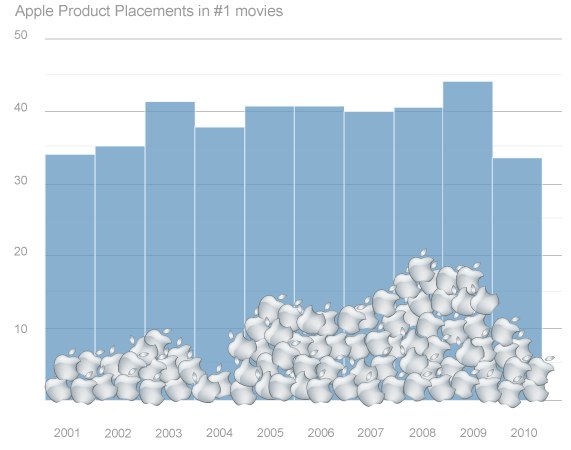
Product placement in top movies

As reported at Engadget:
Interbrand's Brandchannel website dug deep into the fetid bowels of product placement to reveal Hollywood's preferences (paid or personal) in the 33 films that hit the US box office number one slot in 2010. Brandchannel identified 591 total brand or product appearances for an average of 17.9 placements per film, with Apple appearing in ten of the top films for a 30 percent share -- Nike, Chevrolet, and Ford each appeared in eight. Incidentally, Iron Man 2 won the dubious distinction of being cluttered with the most identifiable brands (64) in 2010.

Senin, 28 Februari 2011

"The Cove"


The trailer is self-explanatory. The film won the Academy Award for Best Documentary Feature last year, and the Audience Award at Sundance the same year.  The Guardian reports today that the director has sent DVDs of the film to all of the residents of the town.

Kamis, 24 Februari 2011

"You may have beaten us, but can you solve this integral?"


No time to blog today - very busy with family activities.  But after hearing about Caltech's basketball victory, I did want to quickly repost this item from a year and a half ago:
A couple weeks ago [September 2009], when I posted an article about a victory for "Britain's worst football team" (90 consecutive losses), Mark suggested that I should see the movie "Quantum Hoops." This week I got the DVD from the library.

The movie tells the story of the basketball team at Caltech, one of the top five academic institutions in the world, noted for such nonathlete-students as Richard Feynman, Linus Pauling, and ?Frank Capra. The numbers are incredible - 21 consecutive YEARS without a victory at the time the movie was made - 243 losses in a row. The year before the movie they lost by an average of 60 points per game.

Over the years the teams have been composed of unarguably the brightest (non)athletes in the world. The team in the movie has more valedictorians (8) than students who played varsity basketball in high school (6).

The movie presents the history of the school and its athletic programs and follows the team as they approach a game which they have a chance to win. I won't give the result. You can obviously Google an answer, but that would spoil the dramatic tension. It's a delightful movie, well-suited even for those who don't give a hoot about college sport. Enjoy.
After the movie was released, the basketball team won some nonconference games, but yesterday they ended a 319-game conference losing streak, beating Occidental College 46 to 45.

Kamis, 27 Januari 2011

"Night of the Living Dead"

This is the original (noncolorized) 1968 version by George Romero, "selected by the Library of Congress for preservation in the National Film Registry as a film deemed 'culturally, historically or aesthetically significant.'"
Nationally, it was shown as a Saturday afternoon matinĂ©e — as was typical for horror films at the time — and attracted an audience consisting of pre-teens and adolescents. The MPAA film rating system was not in place until November 1968, so even young children were not prohibited from purchasing tickets. Roger Ebert of the Chicago Sun-Times chided theater owners and parents who allowed children access to the film. "I don't think the younger kids really knew what hit them," he said. "They were used to going to movies, sure, and they'd seen some horror movies before, sure, but this was something else." According to Ebert, the film affected the audience immediately: “ The kids in the audience were stunned. There was almost complete silence. The movie had stopped being delightfully scary about halfway through, and had become unexpectedly terrifying. There was a little girl across the aisle from me, maybe nine years old, who was sitting very still in her seat and crying...

More than 40 years after its release, the film enjoys a reputation as a classic and still receives positive reviews; Night of the Living Dead currently holds a 96% "Certified Fresh" rating on the review aggregate website Rotten Tomatoes
The embed is full-length and has a 1080p option in the control bar, to allow fullscreen viewing.

Rabu, 26 Januari 2011

"The war is not meant to be won. It is meant to be continuous."

"The war is not meant to be won.  It is meant to be continuous.  The essential act of modern warfare is the destruction of the produce of human labor... The war is waged by the ruling group against its own subjects, and its object is not victory over eurasia or Eastasia, but to keep the very structure of society intact."
From the voiceover dialogue of the movie 1984.  Via for screencap photo.

Rabu, 19 Januari 2011

Filming locations for The Third Man

Yesterday, when I posted the final scene from The Third Man, I asked if anyone knew the name of the street where it was filmed.  Chemsolver identified it as a street in "Wiener Zentralfriedhof," the main cemetery in Vienna.  He also appended a link to a remarkable resource for film buffs.

Location Shots in Vienna of The Third Man (1949) correlates scenes from the movie with recent photos of the locations.  Over a hundred stills from the movie are presented, with current information when available, including some continuity mistakes noted in the movie, some commentary ("The current buildings replacing them are supremely boring examples of architecture, only slightly better than the rubble they replaced..."), and up-to-date photos when possible.  The website seems to be an ongoing project with some locations remaining to be identified.  Nicely done.

Selasa, 18 Januari 2011

Anna walks out of Holly's life

I saw this image on a Twitter post by Roger Ebert, and it took me a while to recall the name of the movie...


Does anyone know if this is a famous street in Vienna?

The Third Man is perhaps better known for its musical theme than for its plot (note how excited the women are to be listening to the music).

Selasa, 11 Januari 2011

Creation of the "ice palace" for "Dr. Zhivago"

According to Old Hollywood "Several tons of chipped marble and melted wax were used to simulate ice."

While searching for more information on that, I found these even-more-interesting tidbits at Out of the Past, many of them gleaned from commentaries on the DVD:
When Yuri and Lara first cross paths it's in a trolley. They don't see each other but when they touch accidentally the electric line above the trolley gives off a spark which symbolizes the emotional spark between those two characters.

David Lean's favorite color was yellow and he used yellow flowers, especially sunflowers to represent beauty and hope in the film. In the scene where Yuri and Lara part for the first time, sunflower petals fall mimicking tears.

[Director David Lean] really wanted to focus on her eyes but felt that Christie's soft pillowy lips took away from them. So throughout the film you see that shadows cover the lips or that the light specifically highlights the eyes versus the lips.

David Lean felt that it wasn't necessary to show violence that reaction shots were more important and added more to the drama.

The woman with the dead baby that gets pulled up onto the moving train by Yuri, the actress actually fell under the train and her legs were seriously injured. They used the actual shot of her being pulled under the train.

Author Pasternak's love affair with his mistress Olga is the basis of the love story of Yuri and Lara.

For the scene with the town of Yuriatan burning in the background, Lean had a crew burn 2 tons of rubber tires!

Rabu, 29 Desember 2010

Before workplace safety and child labor laws...

Diana “Baby Peggy” Cary, age 5, in Darling of New York (1923, dir. King Baggot)
“[While filming a fire sequence for Darling of New York], King Baggot and my father walked me through the set and showed me how the crew had lined the windows and the only door with sawdust soaked in kerosene, which would be set afire for the scene. I was warned it would only be “one take” as the set would be completely burned. I was shown the two different windows in the kitchen which would be ablaze when the camera rolled. I was to look at them but turn away and run to the door. It would not be torched by the crew, Baggot said, and I was to escape immediately through that door.

But when filming began and I reached the door I found the crew had mistakenly set it ablaze. The door knob was already too hot to touch. But the camera, Baggot, and my father, shooting from a distance through the window above the kitchen sink, could not see the flames. I knew I could not spoil the scene by explaining the situation to them. So while they kept shouting at me to “GO OUT THE DOOR!” I ran back to the sink and the window above it, which was not burning as fiercely as was the door. Moving fast I clambered through the burning open window and gave the camera an unexpected close up of me escaping through the flames!
Credit to Starts Thursday (which has much more info re the child actress), via Old Hollywood.

Selasa, 28 Desember 2010

Cinematic product placement, 1951

A hat tip to Peter Osgood, who posted the following item at a board discussing the King William's College quiz:
In John Huston's The African Queen (1951), Gordon's was the brand of choice for Charlie Allnut, the hard-drinking riverboat captain, played by Humphrey Bogart.  The Gordon's label is clearly shown in a pivotal scene in which Katharine Hepburn's teetotaling character, Rose Sayer, tosses crates of the beverage into the river.  The appearance of Gordon's gin in The African Queen is frequently cited as one of the first examples of movie product placement.
Photo from Poster Art.  It looks more like a publicity still than a movie screencap.

Senin, 27 Desember 2010

"The Gift" - by Carl Erik Rinsch


A short (5-minute) video described as "a futuristic action thriller which involves a robotic manservant on the run from the Russian police."
...the release of the short film has spawned a bidding war between several big Hollywood movie studios, including Warner Bros and Fox. Everyone wants to turn the short film into a feature... Rinsch is currently developing a remake of Creature From The Black Lagoon and is in preproduction on an epic period samurai film titled 47 Ronin to star Keanu Reeves...
Warning: brief violence, but most of you won't want this to end..

It won a Grand Prix award at Cannes.
In this sci-fi thriller, Podarok introduces us to a dystopian future. It’s a winter’s day in Moscow, but the familiar landscape is not all it seems. The traditional backdrop is balanced by the technological hints to the future on show. An experienced KGB Agent is on his way to deliver a special gift. Expressionless and giving the aura of emptiness the lone man makes his way across the city. As the secret of the gift is unveiled to the receiver, the desire for the object becomes evident. The agent must have it. Even at the cost of a man’s life. A high-octane chase through Moscow ensues as the dead man’s robotic butler tries to rescue the precious gift. It must not be left in the wrong hands.

Jumat, 17 Desember 2010

Ben Chapman, 1928 - 2008

“The reason they didn’t credit me in the movie, and this is crazy, is the studio wanted to give the impression, the illusion, that it was a real creature. If you see the original Frankenstein, Boris [Karloff] doesn’t get credit. It’s a question mark in the credit. I looked at the studio and asked if they thought the people were that stupid, and they said, ‘You’d be surprised what people believe’”
-- Ben Chapman, speaking of his role in the 1954 movie, Creature from the Black Lagoon.

Via Old Hollywood.

Selasa, 14 Desember 2010

Hurdy-gurdy men

This week I watched Fritz Lang's classic movie, M, which starred Peter Lorre as a child murderer (and launched his career as an international star).   It's really quite a remarkable film; so many from that era fail to hold a modern viewer's attention, but this one has production values and acting sequences well above the norm for the era.

In the movie, Lorre is pursued and caught by a collaboration of street people - including hurdy-gurdy men.  It's worth noting before going on that the term "hurdy-gurdy" classically applies to a group of stringed musical instruments that are different from the "barrel organs" typically associated with the term.
In the eighteenth century the term hurdy gurdy was also applied to a small, portable "barrel organ" (a cranked box instrument with a number of organ pipes, a bellows and a barrel with pins that rotated and programmed the tunes) that was frequently played by poor buskers (street musicians). Barrel organs require only the turning of the crank, and the music is played automatically by pinned barrels, perforated paper rolls, and more recently by electronic modules.

This confusion over what the name hurdy gurdy means is particular to English, although similar confusion over other terms for the instrument occurs in German and Hungarian due to unfamiliarity with the hurdy gurdy. The French call the barrel organ the Orgue de Barbarie ("Barbary organ"), and the Germans Drehorgel ("turned organ"), instead of Drehleier ("turning lyre").
By a delightful coincidence, this week I also ran across a set of about 20  photos of Russian, European, and American hurdy-gurdy (barrel-organ) men at This is Major Tom to Ground Control, three of which I've embedded above.  I've not been able to ascertain the original provenance of the photos.

Via Poemas del rio Wang.  (The movie "M" can be viewed online at The Internet Archive.)

Selasa, 23 November 2010

Recognize this young lady?

Photo taken in 1952, when she was 18 and just entering a career of movie stardom and social activism.

Identity revealed at John McNab's Flickr photostream.

Kamis, 04 November 2010

Metropolis (1927) to be broadcast

More re this famous dystopian film here.  And Der Speigel has a report about the restored film being the featured opening presentation at the Berlin Film Festival this week.

Pix via Vintage Blog.

The entire movie can be viewed in 12 videos at YouTube.

Update:  The Turner Classic Movie station (TCM) will be broadcasting a special program on the evening of November 7 entitled "Metropolis Refound," detailing the restoration of the movie.  Earlier that same night their schedule shows a three-hour segment for "Metropolis," but I've been unable to ascertain whether that will be the original or the restored version.

Rabu, 20 Oktober 2010

Luke really wasn't in THAT much danger

"When Darth Vader (David Prowse) revealed his secret to Luke, Hamill was hanging onto a pinnacle above mattresses placed on cardboard boxes about 30 feet off the ground."

From a photo set at Vanity Fair.

Selasa, 28 September 2010

Movies with quicksand

An impressive essay by Daniel Engber at Slate details the history of quicksand in the movies, along with a slideshow of movie clips and a discussion of the erotic and fetishistic aspects of the genre.
It's fitting that one of the earliest known depictions of quicksand comes from one of the earliest known comic strips—a 230-foot-long piece of linen embroidered with wool yarn nearly 1,000 years ago. The Bayeux Tapestry depicts the events leading up to the Norman Conquest, and in one panel, Harold, later King of England, pauses to rescue a pair of soldiers who have become trapped in the mud near Mont St. Michel...

Rabu, 25 Agustus 2010

Color film footage from 1922


The first feature film to be released in Technicolor was Becky Sharp in 1935; it had been preceded by a few live-action films in 1934.  But the video above is of film prepared in 1922 (for reference this is before the first Laurel and Hardy movies).

The process uses Kodachrome film, and is explained at the Kodak A Thousand Words website.
"In these newly preserved tests, made in 1922 at the Paragon Studios in Fort Lee, New Jersey, actress Mae Murray appears almost translucent, her flesh a pale white that is reminiscent of perfectly sculpted marble, enhanced with touches of color to her lips, eyes, and hair..."
The content of the video is largely irrelevant; it appears to be a sort of screen test using a silent movie actress.  What is remarkable is the absolutely jaw-dropping color. 

Via Neatorama.