


If you're a parent of a certain age, your kids' homework can be confounding. Blame it on changes in the way children are taught math nowadays — which can make you feel like you're not very good with numbers...
That's largely to reflect the different needs of society," he says. "No one ever in their real life anymore needs to — and in most cases never does — do the calculations themselves."
Computers do arithmetic for us, Devlin says, but making computers do the things we want them to do requires algebraic thinking. For instance, take a computer spreadsheet. The computer does all the calculations for you automatically. But you have to write the macros that tell it what calculations to do — and that is algebraic thinking.
"You cannot become good at algebra without a mastery of arithmetic," Devlin says, "but arithmetic itself is no longer the ultimate goal." Thus the emphasis in teaching mathematics today is on getting people to be sophisticated, algebraic thinkers...
"Teachers have a very difficult task, and the task they have now is even more difficult, because in previous generations they could assume that in many cases the parents could help."
If you are somewhere else, you are not here.Found in the Futility Closet.
You are not in Rome; you are somewhere else.
Therefore you are not here.

Here is a curious old story that is something like a puzzle: A crocodile stole a baby, ‘in the days when animals could talk,’ and was about to make a dinner of it. The poor mother begged piteously for her child. ‘Tell me one truth,’ said the crocodile, ‘and you shall have your baby again.’ The mother thought it over, and at last said: ‘You will not give it back.’ ‘Is that the truth you mean to tell?’ asked the crocodile. ‘Yes,’ replied the mother. ‘Then by our agreement I keep him,’ added the crocodile; ‘for if you told the truth I am not going to give him back, and if it is a falsehood, then I have also won.’ Said she: ‘No, you are wrong. If I told the truth you are bound by your promise; and, if a falsehood, it is not a falsehood, until after you have given me my child.’ Now, the question is, who won?
The first few powers of 5 share a curious property — their digits can be rearranged to express their value:Found in the Futility Closet.
25 = 52
125 = 51 + 2
625 = 56 – 2
3125 = (3 + (1 × 2))5
15625 = 56 × 125
78125 = 57 × 182
It’s conjectured that all powers of 5 have this property. But no one’s proved it yet.
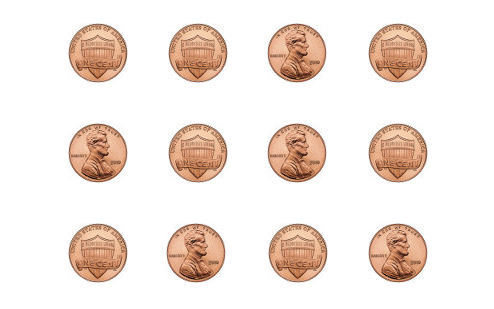
You’re in a pitch-dark room. On a table before you are 12 pennies. You know that 5 are heads up and 7 are tails up, but you don’t know which are which. By moving and flipping the coins you must produce two piles with an equal number of heads in each pile. How can you do this without seeing the coins?I was not able to solve this on my own and had to peek at the answer. Even after seeing the answer, it took me a long time to comprehend why it works.

It takes Deep Thought 7½ million years to compute and check the answer, which turns out to be 42. Unfortunately, The Ultimate Question itself is unknown.
When asked to produce The Ultimate Question, the computer says that it cannot; however, it can help to design an even more powerful computer (the Earth), that can. The programmers then embark on a further ten-million-year program to discover The Ultimate Question. This new computer will incorporate living beings in the "computational matrix", with the pan-dimensional creators assuming the form of mice. The process is hindered after eight million years by the unexpected arrival on Earth of the Golgafrinchans and then is ruined completely, five minutes before completion, when the Earth is destroyed by the Vogons to make way for a new Hyperspace Bypass...
At the end of the first radio series (and television series, as well as the novel The Restaurant at the End of the Universe) Arthur Dent, having escaped the Earth's destruction, potentially has some of the computational matrix in his brain. He attempts to discover The Ultimate Question by extracting it from his brainwave patterns, as abusively suggested by Marvin the Paranoid Android, when a Scrabble-playing caveman spells out forty two. Arthur pulls random letters from a bag, but only gets the sentence "What do you get if you multiply six by nine"?
Some readers subsequently noticed that 613 × 913 = 4213 (using base 13). Douglas Adams later joked about this observation, saying, "I may be a sorry case, but I don't write jokes in base 13."
The number 42 also appears frequently in the work of Lewis Carroll, and some critics have suggested that this was an influence. Other purported Carroll influences include that Adams named the episodes of the original radio series of The Hitchhiker's Guide to the Galaxy "fits", the word Carroll used to name the chapters of The Hunting of the Snark.


The idea of steganography is to hide messages within other information so that no one notices your communications. The word itself comes from a Latin-Greek combination meaning “covered writing”, from earlier physical methods that apparently included tattooing a message on a messenger’s head before letting him grow his hair back to hide it. In the case of digital steganography, it is all done in the math...The technique is explained in detail at the link, and is way over my head, but some of you may understand it.
Amazingly, it is possible to hide another, larger, full-color picture within this image and get it back again with about a dozen lines of Mathematica code. The key to the whole process is to use the least significant bit in each color channel of each pixel as a place to hide information...
In a sufficiently complex image, the human eye doesn’t see the loss of information. The fact that one color channel on a particular pixel might or might not be darker by 1/256 than before cannot be noticed…
"Project Euler is a series of challenging mathematical/computer programming problems that will require more than just mathematical insights to solve. Although mathematics will help you arrive at elegant and efficient methods, the use of a computer and programming skills will be required to solve most problems.Then I peeked at some of the math problems:
The motivation for starting Project Euler, and its continuation, is to provide a platform for the inquiring mind to delve into unfamiliar areas and learn new concepts in a fun and recreational context."
1. Add all the natural numbers below one thousand that are multiples of 3 or 5.As Halsey Hall used to say, "Holy cow!"
2. Find the sum of all the even-valued terms in the Fibonacci sequence which do not exceed four million.
4. Find the largest palindrome made from the product of two 3-digit numbers.
7. Find the 10001st prime.
10. Calculate the sum of all the primes below two million.
In order to optimize the filling [of the flower head with seeds], it is necessary to choose the most irrational number there is, that is to say, the one the least well approximated by a fraction. This number is exactly the golden mean. The corresponding angle, the golden angle, is 137.5 degrees. (It is obtained by multiplying the non-whole part of the golden mean by 360 degrees and, since one obtains an angle greater than 180 degrees, by taking its complement). With this angle, one obtains the optimal filling, that is, the same spacing between all the seeds.Via the Flickr photostream of lucapost, whence also the illustrative image below.
This angle has to be chosen very precisely: variations of 1/10 of a degree destroy completely the optimization. When the angle is exactly the golden mean, and only this one, two families of spirals (one in each direction) are then visible: their numbers correspond to the numerator and denominator of 2 consecutive numbers in the Fibonacci sequence, which is proved to converge toward the Golden Mean value of 1.6180339... (in the picture we have 21/34, the 7th and 8th terms of the Fibonacci sequence).
Moreover, generally the petals of flowers are formed at the extremity of one of the families of spiral (true, I count 34 for this sunflower). This then is also why the number of petals corresponds on average to a Fibonacci number.

In English, the name of each integer shares a letter with EACH of its neighbors. ONE shares an O with TWO, TWO shares a T with THREE … and so on to infinity.


A partir d'un carré central de côté 1, on construit un nouveau carré qui s'appuie sur le précédent. Puis on répète la construction, chaque nouveau carré appuie son côté sur l'ensemble des carrés déjà construits. Dans chaque carré, on trace un quart de cercle joignant un sommet au sommet opposé, de sorte que les quarts de cercle soient consécutifs. La courbe obtenue s'appelle la spirale de Fibonacci.Photo credit Contra Natura and Labregonet , via Titam.


