The first part of the ecological burial method involves removing the water that makes up 70% of the human body. To do this, the company freeze-dries the corpse in liquid nitrogen within a week and a half after death. The corpse is first frozen to -18°C (0°F) and then submerged in liquid nitrogen. Next, sound waves at a specific amplitude vibrate the brittle corpse, transforming it into an organic white powder. The powder is sent through a vacuum chamber that evaporates the water, greatly decreasing the corpse’s mass...Personally, I'd like to have a Tibetan sky burial, but that seems impractical...
At this point, the organic powder is hygienic and odorless, and the remains can either be cremated or buried. Since the powder will not decompose if kept dry, there is no hurry for a burial. At the time of burial, the remains are laid in a coffin made of a biodegradable material such as corn starch and placed in a shallow grave. Depending on the wishes of the next of kin, a bush or tree can be planted above the coffin. Within 6-12 months, both the coffin and its contents will become loam, a high-nutrient soil that nourishes the plant growing above.

Tampilkan postingan dengan label TYWKIWDBI. Tampilkan semua postingan
Tampilkan postingan dengan label TYWKIWDBI. Tampilkan semua postingan
Rabu, 09 Maret 2011
Ecological burial: freeze-drying and composting
I first wrote about promession in this blog two years ago. This week PhysOrg provides some updated information.

Selasa, 08 Maret 2011
Ancient Nubians consumed tetracycline-laced beer

A chemical analysis of the bones of ancient Nubians shows that they were regularly consuming tetracycline, most likely in their beer. The finding is the strongest evidence yet that the art of making antibiotics, which officially dates to the discovery of penicillin in 1928, was common practice nearly 2,000 years ago.Fascinating.
The research, led by Emory anthropologist George Armelagos and medicinal chemist Mark Nelson of Paratek Pharmaceuticals, Inc., is published in the American Journal of Physical Anthropology...
Armelagos is a bioarcheologist and an expert on prehistoric and ancient diets. In 1980, he discovered what appeared to be traces of tetracycline in human bones from Nubia dated between A.D. 350 and 550, populations that left no written record. The ancient Nubian kingdom was located in present-day Sudan, south of ancient Egypt...
“The bones of these ancient people were saturated with tetracycline, showing that they had been taking it for a long time,” he says. “I’m convinced that they had the science of fermentation under control and were purposely producing the drug.”..
Even the tibia and skull belonging to a 4-year-old were full of tetracycline, suggesting that they were giving high doses to the child to try and cure him of illness, Nelson says.
The first of the modern day tetracyclines was discovered in 1948. It was given the name auereomycin, after the Latin word “aerous,” which means containing gold. “Streptomyces produce a golden colony of bacteria, and if it was floating on a batch of beer, it must have look pretty impressive to ancient people who revered gold,” Nelson theorizes.
Disposal of "illegal caviar" in Russia


I can't conceive of a reason to burn it before burial (presumably a show for the cameras), but what saddens me is to think of how many sturgeon were killed to obtain caviar that is being buried, since presumably the rogue harvesters were not utilizing modern fish milking techniques.
Did Henry VIII carry the Kell antigen and have McLeod syndrome?
Excerpts from a report at ScienceDaily:
Research conducted by bioarchaeologist Catrina Banks Whitley while she was a graduate student at SMU (Southern Methodist University) and anthropologist Kyra Kramer shows that the numerous miscarriages suffered by Henry's wives could be explained if the king's blood carried the Kell antigen. A Kell negative woman who has multiple pregnancies with a Kell positive man can produce a healthy, Kell positive child in a first pregnancy; But the antibodies she produces during that first pregnancy will cross the placenta and attack a Kell positive fetus in subsequent pregnancies.Very interesting. Here's a link to Whitley and Kramer's publication.
As published in The Historical Journal (Cambridge University Press), the pattern of Kell blood group incompatibility is consistent with the pregnancies of Henry's first two wives, Katherine of Aragon and Anne Boleyn. If Henry also suffered from McLeod syndrome, a genetic disorder specific to the Kell blood group, it would finally provide an explanation for his shift in both physical form and personality from a strong, athletic, generous individual in his first 40 years to the monstrous paranoiac he would become, virtually immobilized by massive weight gain and leg ailments...
A Kell positive father frequently is the cause behind the inability of his partner to bear a healthy infant after the first Kell negative pregnancy, which the authors note is precisely the circumstance experienced with women who had multiple pregnancies by Henry. The majority of individuals within the Kell blood group are Kell negative, so it is the rare Kell positive father that creates reproductive problems...
McLeod syndrome resembles Huntington's disease, which affects muscle coordination and causes cognitive disorder. McLeod symptoms usually begin to develop when an individual is between 30 and 40 years old, often resulting in damage to the heart muscle, muscular disease, psychiatric abnormality and motor nerve damage. Henry VIII experienced most, if not all, of these symptoms, the authors found...
The precise number of miscarriages endured by Henry's reproductive partners is difficult to determine, especially when various mistresses are factored in, but the king's partners had a total of at least 11 and possibly 13 or more pregnancies. Only four of the eleven known pregnancies survived infancy. Whitley and Kramer call the high rate of spontaneous late-term abortion, stillbirth, or rapid neonatal death suffered by Henry's first two queens "an atypical reproductive pattern" because, even in an age of high child mortality, most women carried their pregnancies to term, and their infants usually lived long enough to be christened...
The survival of Mary, the fifth pregnancy for Katherine of Aragon, fits the Kell scenario if Mary inherited the recessive Kell gene from Henry, resulting in a healthy infant.
Senin, 07 Maret 2011
Ajolote (Mexican mole lizard)

Fossorial and seldom seen, precious little is known about the biology of the 160 or so described species of worm lizard. Almost all of them live in the tropics or sub-tropics and it is their admirable adaptations for a subterranean existence that really single them out. Along with their limbs they have all but lost their eyes and they retain just the vestiges of these organs – tiny, beady and covered with a thin scale...More at the link, which also has a video showing the ajolote trying to burrow into loose soil. And at H.E.R.P. I found this photo, which gives a better size indication.
Worm lizards make their tunnels by using their head like a battering ram, a rather brutal, yet effective technique necessitating a heavily reinforced skull where there individual bones of skull are all fused. Some species have a spade-shaped head, which is used to compress the soil into the top of the tunnel, while other species have a keel shaped head they use to press the soil in to the sides of the tunnel by vigorously moving their head from side to side...
In Latin, Amphisbaena means to ‘move in both ways’ reflecting the animal’s ability to move forwards and backwards equally well. Also, in myth and legend the amphisbaena was a fabulous beast with a head at either end of its body, perhaps the brainchild of a medieval chronicler who saw a worm lizard in its defensive posture...

Minggu, 06 Maret 2011
Three folding bathtubs
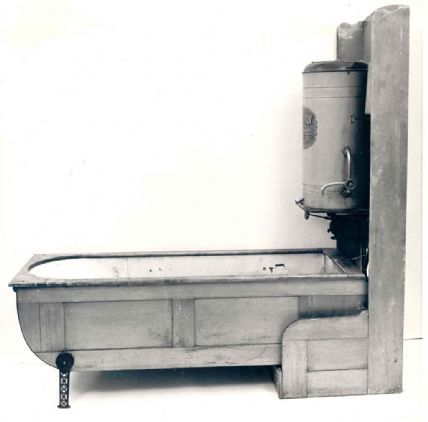

The Mosely Folding Bath Company advertised a folding bath in the 1895 Montgomery Ward Catalog. This tub, disguised as a mirrored wardrobe, folded down and out of its wood casing into the room, revealing the heater above.The bathtub was not connected to drainage plumbing, so it had to be scooped out after use.
Via Historical Indulgences.
Addendum: Stella remembered having seen one on Antiques Roadshow years ago, so I tracked it down at PBS:


Spies masquerading as butterfly enthusiasts

"This sketch of a butterfly contains the outline of a fortress, and marks both the position and power of the guns. The marks on the wings between the lines mean nothing, but those on the lines show the nature and size of the guns, according to the keys below."

"The marks on the wings reveal the shape of the fortress shown here and the size of the guns. The position of each gun is at the place inside the outline of the fort on the butterfly where the line marked with the spot ends. The head of the butterfly points towards the north."
---From My Adventures as a Spy, by Sir Robert Baden-Powell.
A detailed discussion of naturalists as spies is presented at the Opinionator blog at the NYT.
...over the years I’ve found that naturalists don’t actually like the connection at all. The suspicion that they may be spies just complicates the difficult job of getting access to habitats and specimens in foreign countries, which are often already leery of their odd collecting behavior. It can also get them jailed, or even murdered...More at the link, via The Daily Dish.
The most public of them was Sir Robert Baden Powell, better known as founder of the Boy Scouts. As a British secret agent, he thought it clever to pose as “one of the exceedingly stupid Englishmen who wandered about foreign countries sketching cathedrals, or catching butterflies.” His detailed maps of enemy fortifications were concealed within the natural patterns of butterfly wings and tree leaves...
Maxwell Knight, the British counterintelligence spymaster (and one of the models for James Bond’s boss M), actually worked on the side as a BBC natural history presenter and author. In the late 1950s, he hired a young man named David Cornwell to provide bird illustrations for one of his books, leading Cornwell into a stint as an MI5 intelligence officer in Germany — and later to a career as the novelist John Le Carré.
Jumat, 04 Maret 2011
How pine trees affect local temperature in winter

You can clearly see the darker shading to the landscape over northern Minnesota, pine trees appear darker from space - lower albedo absorbing more warmth from the suun, keeping temperatures a few degrees warmer.From meteorologist Paul Douglas' On Weather blog.
Famous Minnesotans

Loni Anderson, Louie Anderson, the Andrews sisters, Harry Blackmun, the Coen brothers, Gordon R. Dickson, Bob Dylan, F. Scott Fitzgerald, Neil Gaiman, Judy Garland, J. Paul Getty, Terry Gilliam, Billy Graham, George Roy Hill, Hubert Humphrey, Garrison Keillor, Elizabeth Kenny, Ann Landers, Jessica Lange, Sinclair Lewis, Charles Lindbergh, Roger Maris, E. G. Marshall, Bobby McFerrin, Walter Mondale, Robert Mondavi, Gordon Parks, Prince, Charles M. Schulz, Eric Sevareid, Jesse Ventura, and of course Rocky and Bullwinkle.I'm posting this mostly for my own amusement, but also to alert readers that Wikipedia has many hundreds of "lists of people from..." Fill in the blank to find persons from your own neck of the woods.
Pic via James Lileks' The Bleat.
Kamis, 03 Maret 2011
Queen Victoria's final companion

"I am so very fond of him. He is so good and gentle and understanding… and is a real comfort to me.”Fascinating.
These were the words of Queen Victoria speaking to her daughter-in-law, Louise, Duchess of Connaught, on November 3, 1888, at Balmoral. Perhaps surprising, though, is who she was talking about – not her beloved husband, Albert, who had died in 1861. Nor John Brown, her loyal Scottish ghillie, who in many ways filled the void left by Albert, since Brown had died in 1883.
Instead, Queen Victoria was referring to Abdul Karim, her 24-year-old Indian servant.
Her relationship with Karim was one that sent shockwaves through the royal court – and ended up being one of the most scandalous periods of her 64-year reign.
Indeed, such was the ill-feeling that when Victoria died, her son King Edward ordered all records of their relationship, including correspondence and photographs, to be destroyed.
But a new archive of letters, pictures and Karim’s “lost diary”, held secretly by his family for more than a century, sheds new light on their relationship.
The documents tell the story of how Karim arrived in England in 1887 and quickly gained the affection of a monarch 42 years his senior. They chart the remarkable rise of the clerk from Agra in northern India to one of Victoria’s closest and most influential friends...
The author Shrabani Basu discovered the documents after writing Victoria & Abdul, her book on the remarkable relationship between the Queen and her Indian servant... Basu flew from London to Karachi in Pakistan. She was handed the diary – a neat brown journal with gold edges, recognisable as the stationery used in Windsor. It contained a record of Karim’s 10 years in London between the Golden and Diamond jubilees. The pages were also filled with photographs and magazine cuttings. It had been smuggled out of India by the family when they had fled in 1947 following the Partition riots, then kept a closely guarded secret until Basu’s visit...
Karim introduced curry to the royal menu and started teaching her to speak Urdu, offering lessons every evening. As Empress of India – and a committed Indophile – nothing pleased her more...
Henceforth Karim travelled everywhere with the Queen, even on her tours of Europe, meeting numerous monarchs and prime ministers along the way. The Queen allowed him to move his wife over to England, and the couple were given their own cottage on each of her estates...
Still, many in the royal court were unhappy with Karim’s constant presence. He was forever by her side and the Queen, a prolific letter-writer, often sent him several letters a day... The courtiers’ fears had some substance. Since Karim saw every letter that the Queen sent, he was soon advising her on how to deal with sectarian problems between Muslims and Hindus – advice she passed on to the bemused Viceroy. Unsurprisingly, her solutions always seemed to favour the Muslims – Karim, of course, was a Muslim...
Abdul had created a phrase book of everyday Urdu words for the Queen to use when speaking to her Indian servants, as well as visiting royalty, and has written them out in Roman script.
The phrases include the standard ones such as: “You may go home if you like” (Tum ghar jao agar chhate ho); and: “The egg is not boiled enough”.
But some of the phrases are significantly more intriguing. For instance: “You will miss the munshi very much” (Tum munshi ko bahut yad karoge). And: “Hold me tight” (Ham ko mazbut thamo)...
The Windsor documents also contain letters from Queen Victoria to Karim, frequently concerning his wife (towards whom, it would appear, she was equally fond), signed: “dearest mother”; or “Your loving mother, Victoria R.I.”
She nearly always signed these in Urdu.
(Extracted from 'Victoria & Abdul’ by Shrabani Basu, published by The History Press March 7.)
Rabu, 23 Februari 2011
Mark Twain relates an anecdote about the remarkable Helen Keller

"The guests were brought one after another and introduced to her. As she shook hands with each she took her hand away and laid her fingers lightly against Miss Sullivan's lips, who spoke against them the person's name. When a name was difficult, Miss Sullivan not only spoke it against Helen's fingers but spelled it upon Helen's hand with her own fingers - stenographically, apparently for the swiftness of the operation was suggestive of that...Text found at pg. 425 of Volume 1 of the newly-released Autobiography of Mark Twain. Photo: Helen Keller Foundation, via Awesome Stories.
After a couple of hours spent very pleasantly, some one asked if Helen would remember the feel of the hands of the company after this considerable interval of time, and be able to discriminate the hands and name the possessors of them. Miss Sullivan said "Oh she will have no difficulty about that." So the company filed past, shook hands in turn, and with each handshake Helen greeted the owner of the hand pleasantly and spoke the name that belonged to it without hesitation..."
Selasa, 22 Februari 2011
Snowbound cars are catching fire
From the Mpls/St. Paul StarTribune:
About a dozen cars caught fire in St. Paul during Sunday's storm, according to St. Paul Fire Marshal Steve Zaccard.I've "rocked" a car before to get it unstuck; I never realized such maneuvers endangered the transmission. You learn something every day.
He said most of the fires probably started when drivers got stuck in the snow and began rocking their vehicles back and forth in an attempt to get free, overheating the transmission and causing engine fires...
Senin, 21 Februari 2011
"Saucered and blowed"
This colloquial expression, often used to refer "to coffee, too hot to drink until it was poured into the saucer for a moment, blown on, and then drunk from the saucer," is discussed at World Wide Words. I was surprised at how far back the roots of the phrase can be traced:
The expression is certainly American, turning up at various times in the south and west of the country... In the negative it meant something hadn’t yet been made fully ready — a football coach commented on one of his young players in the Charleston Gazette in 1972 that “He has a long way to go. He hasn’t been saucered and blown yet.”..
The idea goes back a long way, of course, much further than the expression itself. A squib appeared in a British newspaper two centuries ago, in which a Frenchman asked a friend to advise on the correctness of his manners at dinner:“And the coffee?” “There I am certain I was right; it was boiling hot, and I poured it in small portions into my saucer.” “Which was what no one else did; every body takes his coffee in his cup, and never in his saucer.” The Courier (Middlesex), 21 Mar. 1826.
The link concludes with an (?)apocryphal story about George Washington saying "“we pour our legislation into the Senatorial saucer to cool it.”
"Slave children from New Orleans"

A search of the Library of Congress archives reveals quite a few additional photographs of these children, such as this one -

Rebecca Huger is eleven years old, and was a slave in her father's house, the special attendant of a girl a little older than herself. To all appearance she is perfectly white. Her complexion, hair, and features show not the slightest trace of negro blood. In the few months during which she has been at school she has learned to read well, and writes as neatly as most children of her age. Her mother and grandmother live in New Orleans, where they support themselves comfortably by their own labor. The grandmother, an intelligent mulatto, told Mr. Bacon that she had "raised" a large family of children, but these are all that are left to her.I'm sure much additional information can be found on this rather interesting topic.
Rosina Downs is not quite seven years old. She is a fair child, with blonde complexion and silky hair. Her father is in the rebel army. She has one sister as white as herself, and three brothers who are darker. Her mother, a bright mulatto, lives in New Orleans in a poor hut, and has hard work to support her family.
Charles Taylor is eight years old. His complexion is very fair, his hair light and silky. Three out of five boys in any school in New York are darker than he. Yet this white boy, with his mother, as he declares, has been twice sold as a slave. First by his father and "owner," Alexander Wethers, of Lewis County, Virginia, to a slave-trader named Harrison, who sold them to Mr. Thornhill of New Orleans. This man fled at the approach of our army, and his slaves were liberated by General Butler. The boy is decidedly intelligent, and though he has been at school less than a year he reads and writes very well. His mother is a mulatto; she had one daughter sold into Texas before she herself left Virginia, and one son who, she supposes, is with his father in Virginia.
These three children, to all appearance of unmixed white race, came to Philadelphia last December, and were taken by their protector, Mr. Bacon, to the St. Lawrence Hotel on Chestnut Street. Within a few hours, Mr. Bacon informed me, he was notified by the landlord that they must therefore be colored persons, and he kept a hotel for white people. From this hospitable establishment the children were taken to the "Continental," where they were received without hesitation.
Via Historical Indulgences.
Minggu, 20 Februari 2011
"Tears of wine (or bourbon)" explained
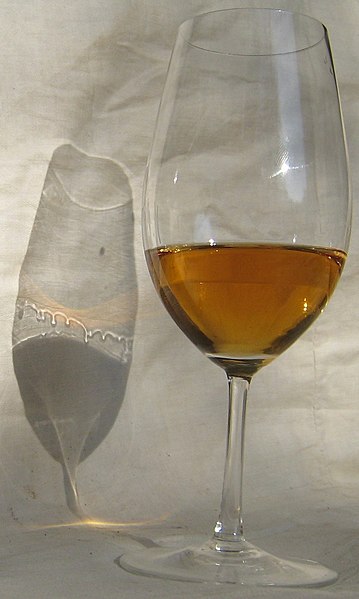
The phenomenon called tears of wine is manifested as a ring of clear liquid, near the top of a glass of wine, from which droplets continuously form and drop back into the wine. It is most readily observed in a wine which has a high alcohol content. It is also referred to as wine legs, curtains, or church windows...Followed by this interesting notation:
Where the surface of the wine meets the side of the glass, capillary action makes the liquid climb the side of the glass. As it does so, both alcohol and water evaporate from the rising film, but the alcohol evaporates faster, due to its higher vapor pressure. The resulting decrease in the concentration of alcohol causes the surface tension of the liquid to increase, and this causes more liquid to be drawn up from the bulk of the wine, which has a lower surface tension because of its higher alcohol content. The wine which moves up the side of the glass and forms droplets that fall back under their own weight...
It is sometimes claimed incorrectly that wine with "lots of legs" is sweeter or of a better quality. In fact the intensity of this phenomenon depends only on alcohol content, and it can be eliminated completely by covering the wine glass (which stops the evaporation of the alcohol). British physicist C. V. Boys argues[4] that the biblical injunction“Look not thou upon the wine when it is red, when it giveth his colour in the cup, when it moveth itself aright.” —Proverbs, 23:31refers to this effect. Since the "tears of wine" are most noticeable in wine which has a high alcohol content, the author may be suggesting this as a way to identify wines which should be avoided in the interest of sobriety.
Beading refers to the formation of stable bubbles when liquor is shaken. This occurs only in liquor that contains more than 46% alcohol. It is an example of the Marangoni effect. Shaking a whisky bottle to form bubbles is referred to as “beating [beading] the whisky”.I've added "bourbon" to the title this post after discovering that a video is available of the phenomenon using my favorite recreational beverage:
Sabtu, 19 Februari 2011
A komondor

A Komondorak in the ring during the 135th Westminster Kennel Club Dog Show at Madison Square Garden.
(Timothy A. Clary/AFP/Getty Images) (source)
Selected interesting information from Wikipedia:
The Komondor (Hungarian plural komondorok) is a large white-colored Hungarian breed of livestock guardian dog with a long, corded coat. They are sometimes referred to as mop dogs. The Komondor is an old-established powerful dog breed which has a natural guardian instinct to guard livestock and other property. The Komondor was mentioned for the first time in 1544 in a Hungarian codex. The Komondor breed has been declared one of Hungary’s national treasures, to be preserved and protected from modification...
The Komondor is built for livestock guarding... the coat of the dog looks similar to that of a sheep so it can easily blend into a flock and camouflage itself giving it an advantage when predators such as wolves attack...
A fully mature coat is formed naturally from the soft undercoat and the coarser outer coat combining to form tassels, or cords and will take around two years to form. Some help is needed in separating the cords so the dog does not turn into one large matted mess... Traditionally the coat protected the Komondor from wolves' bites, as the bites were not able to penetrate the thick coat. The coat of the Komondor takes about two and a half days to dry after a bath...
Sabtu, 12 Februari 2011
Word of the day: cryoseism ("frost quake")
When I saw this story in the Dayton Daily News (via Fark), I thought it might be a joke:
Frost quakes, a rare phenomena that simulate earthquakes, rattled hundreds of residents Thursday in Darke and Miami counties in Ohio and Randolph County in Indiana, emergency management officials said.I found confirmation of the phenomenon at Wikipedia:
The quake, or cryoseism as it’s known in scientific circles, occurs when moisture soaks into the soil and a quick freeze causes a sudden, even violent expansion and contraction. Darke County’s 911 director Brandon Redmond... who lives in Arcanum, experienced it Thursday morning in the shower. The shaking of his house caused him to rush out of the bathroom at 7:15 a.m...
The phenomenon has been reported mainly in northern states such as Maine, Michigan, Massachusetts and upstate New York.
Due to the perennial or seasonal frost conditions involved with cryoseisms, these events are limited to temperate climates which experience seasonal variation with subzero winters. Furthermore, the ground must be saturated with water, which can be caused by snowmelt, rain, sleet or flooding and the site of a cryoseism generally has little or no snow cover to insulate the ground.You learn something every day.
Selasa, 08 Februari 2011
Human zoo specimens

"These five members of the Kawesqar tribe, which is home in Tierra del Fuego in Chile’s far south, were kidnapped in 1881 and sent to Europe to be displayed in “human zoos.” The five died in Zürich a year after their capture."Found at First Time User.
Minggu, 06 Februari 2011
How to achieve record low temperatures
Everyone knows that you need an "Arctic cold front" to move through, but there are additional factors, as explained by Steven A. Acherman and Jonathan Martin at the
Sunday was the 60th anniversary of the coldest day ever recorded in Madison: January 30, 1951. The temperature that day reached an astounding 37 degrees below zero.
To get that cold, a lot of circumstances have to be in place. First, a fresh and relatively deep snow cover is a great help as snow radiates infrared energy exceptionally well. With the long nighttime hours of mid-winter, by the end of the night, a lot of energy has been radiated away from the surface of the snow, chilling the air just above it...
Second, crystal clear nights are needed to maximize the amount of energy loss near the surface... The calm winds prohibit vertical mixing of the air, again working toward keeping the near surface temperature as cold as possible. In fact, on the morning of January 30, the air temperature about 2 miles above the ground was minus-18 — a full 20 degrees warmer than the air at the surface. Had there been even light winds that night, some of that warmer air could have mixed to the surface and kept the temperature from getting as cold as it did.
"Palin" is Greek for "again"
You learn something every day. Last night I was using the apparent last hours of free access to the online OED to look up words, including "ecpyrosis," which turned out to be a Stoic belief in the periodic destruction of the cosmos by a great conflagration, recreated by palingenesis.
Then of course I needed to find out what palingenesis was. The Stoics used the term for the continual re-creation of the universe by the Creator after its absorption into himself, and...
Then of course I needed to find out what palingenesis was. The Stoics used the term for the continual re-creation of the universe by the Creator after its absorption into himself, and...
"In biology, it is another word for recapitulation - the phase in the development of an organism in which its form and structure pass through the changes undergone in the evolution of the species. In theology, the word can be used to refer to reincarnation and Christian spiritual rebirth during baptism."I wonder if she knows that? Could she incorporate it into her campaign? If so, she will need to be aware of a politically incorrect aspect of the word...
Although Josephus used the term for the national restoration of the Jews, the core tenets of the political ideology of fascism earn its description as a "palingenetic ideology", primarily as a result of the notion that fascism itself is the rebirth of a state and/or empire in the image of that which came before it - thus, the ancestral political underpinnings. Specifically academic political theorist Roger Griffin refers to fascism as "palingenetic ultranationalism". The best examples of this can be found with both Fascist Italy and Nazi Germany - Italy looking to establish a palingenetic line between the 20th century regime under Benito Mussolini as being the second incarnation of the Roman Empire, while Adolf Hitler's regime was seen as being the third palingenetic incarnation - beginning first with the Holy Roman Empire ("First Reich") then with Bismarck's German Empire ("Second Reich") and then resulting in Nazi Germany ("Third Reich").
Langganan:
Postingan (Atom)