Speaking about Paul Nicklen is for me speaking about one of my favourite photographers. One whose pictures has contibuted so much in seeding inside me that deep love for nature that I feel and in making me decide to become a photographer myself. He is one of the most prized National Geographic photographer and inside that glorious fellowship he is the undisputed Polar expert. The picture here above, one of the most famous Polar Bear images of all time is one of his masterpieces. In the following short video he disclose to us the story behind this image:
This video is one episode from the National Geographic's "Behind the photo" series. A collection of really interesting clips about the background of many of the most famous National Geographic pictures.
When i saw these pictures for the first time, I thought it was very difficult to post something about this topic. I simply prefer nature when it's alive. But on the other hand it's really something that people should be aware of. And we have to be aware of it because we are the source of the problem. There's no better way, however, to explain it using the author's own words:
"These photographs of albatross chicks were made just a few weeks ago on Midway Atoll, a tiny stretch of sand and coral near the middle of the North Pacific. The nesting babies are fed bellies-full of plastic by their parents, who soar out over the vast polluted ocean collecting what looks to them like food to bring back to their young. On this diet of human trash, every year tens of thousands of albatross chicks die on Midway from starvation, toxicity, and choking.
To document this phenomenon as faithfully as possible, not a single piece of plastic in any of these photographs was moved, placed, manipulated, arranged, or altered in any way. These images depict the actual stomach contents of baby birds in one of the world's most remote marine sanctuaries, more than 2000 miles from the nearest continent." Chris Jordan, October 2009
Could you imagine 1.2 million geese together? I've never been so lucky to see so many animals all together, at most I've seen some thousands mosquitos attacking me in a ricefield... but that was not a nice experience! However, photographer and storm chaser Mike Hollingshead had the chance to film and photograph one of nature's most amazing displays: 1.2 million snow geese all together. He was in the Squaw Creek National Wildlife Refuge near Mound City Missouri between February 17 and March 14, 2009. In that period of the year the snow geese spring migration takes place through the Central Flyway and hundreds of thousands (this year, more than a million) pass through the refuge.
Curiously at the beginning of the 20th century the Snow Geese were in decline but the population had increased of more than 300 percent since the mid-1970s and keeps increasing at a rate of more than 5 percent per year. Population indices are the highest they have been since population records have been kept, and evidence suggests that large breeding populations are spreading to previously untouched sections of the Hudson Bay coastline. They have increased to the point that the tundra breeding areas in the Arctic and the saltmarsh wintering grounds are both becoming severely degraded, and this affects other species using the same habitat.
Apart ecological concerns this is indeed an astonishing show. In the following video Mike Hollingshead give us a better idea of what I'm talking about because sometimes pictures does not justice to something so huge, dynamic and loud!
Check Mike Hollingshead's website www.extremeinstability.com at the snow geese page to see many other of his shots from this mind-blowing migration and don't forget to take a look to his storm pictures too!
I've already spoken about National Geographic Wallpapers several times because they're wonderful and they are a great free-to-download resource to breath a little bit of wildlife. They are updated each month with the best pictures from NG photographers. This month (April 2009) I particularly like the shot, you can see here above, of a young bear taking a leap between small ice drifts. The connection with the global warming and the heavy consequencies it's having on Polar Bear's habitat is obvious and the colours of the water are truly amazing. The author of this picture is Paul Nicklen one of my favourite National Geographic photographers, famous for his great reportages of the arctic world. This picture infact it's part of a National Geographic set dedicated to the Svalbard archipelago that can be foundhere.
Svalbard islands are a naturalistic paradise of immeasurable beauty for all the arctic environnment. Unfortunately the global warming is endangering this icy eden that had already lost the 30% of the ice coverage that there was in the 1979. Paul Niclen images lead us in this wonderful place where the nature is still truly WILD. Let's hope it may continue this way in the future centuries:
Photography by Paul Nicklen, via NGM Photography by Paul Nicklen, via NGM Photography by Paul Nicklen, via NGM Photography by Paul Nicklen, via NGM Photography by Paul Nicklen, via NGM Photography by Paul Nicklen, via NGM Photography by Paul Nicklen, via NGM Photography by Paul Nicklen, via NGM Photography by Paul Nicklen, via NGM Photography by Paul Nicklen, via NGM Photography by Paul Nicklen, via NGM Photography by Paul Nicklen, via NGM Photography by Paul Nicklen, via NGM
If you've liked these pictures check the whole NG gallery here., where you can also read all the captions of these wonderful photographs
A dry river, a grounded boat, a parasol closed. And a storm coming. With a promise of change. The communicativeness of this photograh is so effective... isn't it? I'm not the only one who thinks so and infact it has just won The Moran Contemporary Phootographic Prize, the biggest photo award in Australia. The author, Dan Sewell has won 80,000 australian dollars. The background of the image is the dry river bed of the Murray-Darling Basin and the drought-stricken land of Australia. Murray River is Australia's largest river but the terrible drought (one of the causes of the terrible blazes of the last weeks) has made it that way. At least until the rain.
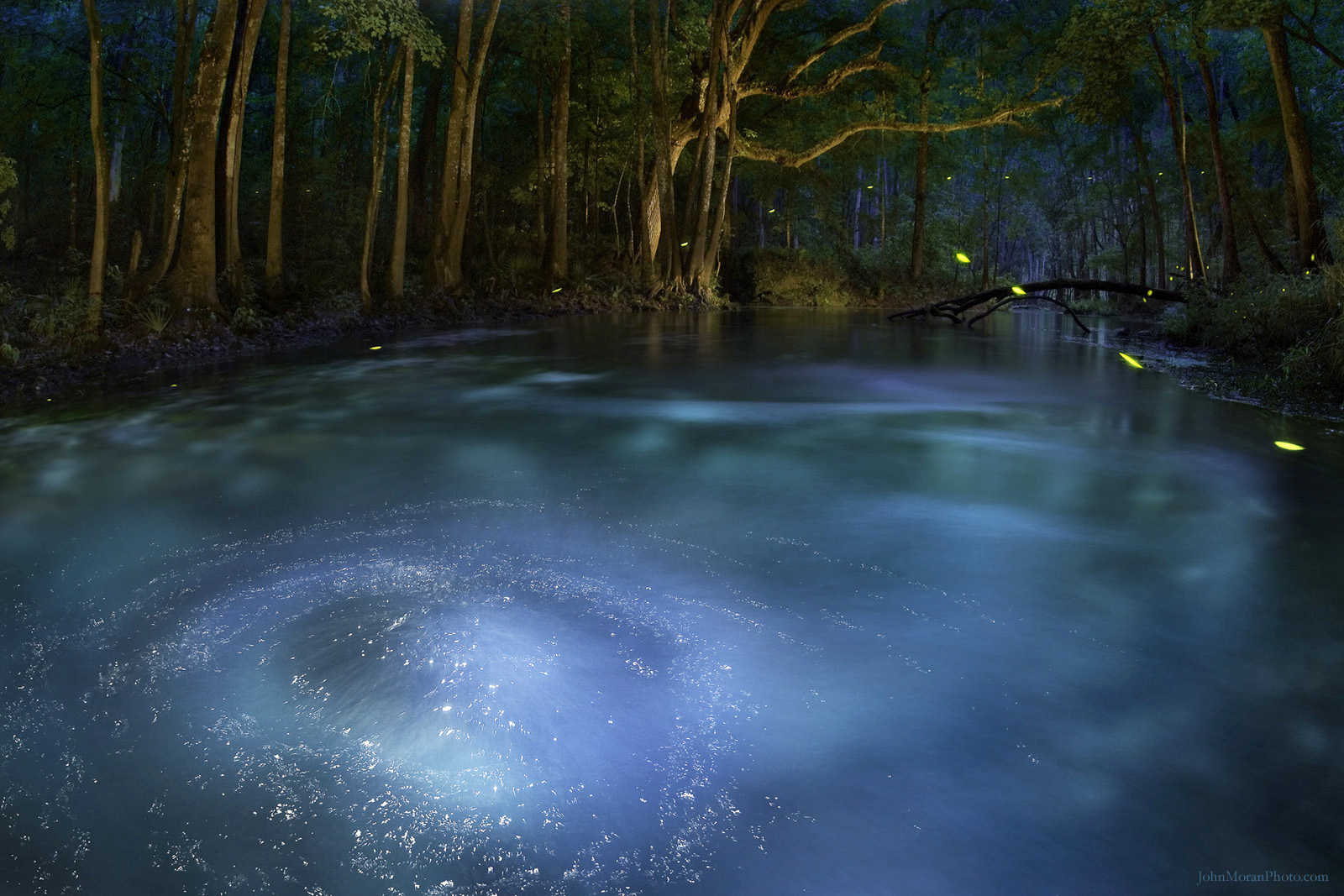
Awesome. This is for sure one of the best picture I've seen in my life. Everything is perfect both in the shooting and in the post processing. The author is John Moran a photographer based in Florida who has a mind-blowing portfolio of nature photography. If you take a look to his images, and you really should, Florida will suddenly jump at the top of your dream vacations list. Believe me.
The Ichetucknee is the wonderful pristine river you see in the picture placidly flowing after the sunset. Mill Pond Spring is the name of the gushing pulse of water you can see lit by the moonbeams. The camera has captured the flashing trajectories of the fireflies giving the finishing touches to a dreamlike atmosphere.
This time I feel the 472 pixels width a limit as tight as never before. Therefore the best thing you can do is clicking the following link to see the picture on John Moran's own site in all his glory: River of Dreams · Fireflies on the Ichetucknee
and then read the beautiful story behind the picture. Because Moran has written a nice page about it, full of poetry, which is also a fight for the preservation of the Ichetucknee river manaced by pollution and algae bloom. This story is here: The Evolution of a Photograph by John Moran
And of course do not forget to see John Moran's portfolio on his own website
The Pirelli Calendar (or simply "The Cal", as it is nicknamed) it's much more than what the word calendar could occur to you. For more than 40 years it has been an object of cult for photography lovers, beauty and elegance fan as well as scholars of costume history. It's not even for sale and its distribution does not follow any commercial logic. The 36th edition of this "work of art" have been recently presented in Berlin. You may think this is a quite unusual topic for this blog but the truth is that it is not because this edition have a strong environmental message and as you can see in the images below the majority of the pictures are strictly related to the water. The photographer of this edition is Peter Beard, a real genius and artist of visual communication. The pictures are set in uncontainated regions of Africa like the Okavango Delta (look at it via Google Maps) which have always been the elected places for Beard work. Peter Beard have strongly brought his own pictorial style in the calendar, creating 56 plates which himself defined "a living sculpture". Marco Tronchetti Provera, Pirelli's President has judged it as the best edition ever and I totally agree with him. As I was telling before Beard pictures are related to climatic changes, global warming and impoverishment of the environmental resources and this kind of message has deeply involved the whole production process of the Cal: Joining LifeGate project infact, Pirelli will create and protect a new forest are in Costa Rica, able to absorb the CO2 emissions created by the production and printing of the calendar as well as by the presentation gala. On top of that the Calendar has been printed on natural porous paper lead-free. Kudos to Pirelli for this way of thinking.
If you do not know Peter Beard's work visit his Official Site.
Yann Arthus-Bertrand is a famous photographer author of those beautiful pictures of the earth seen from above. If you haven't seen his pictures you really should do it as soon as possible. Your chance could be next year in New York when Yann Arthus-Bertrand will bring his work back to the United States for the first time in 2009. The exhibition of his amazing aerial shots aimed to inspire people to think globally about sustainable living, will be on display in New York City at the World Financial Center Plaza and along the Battery Park City Esplanade from May 1, 2009 to June 28, 2009 in over 150 4-ft. by 6-ft. prints. When completed in New York City, the Earth From Above exhibit will also move on to California in 2010.