Like many older couples, my wife and I have lots of LP records, and we would like to convert some of that music to a format we can enjoy on our computers. A recent article in MacWorld magazine discussed usb turntables, recommending products from Numark and Sony.
I don't want to invest a lot of $ into this endeavor. Would it be possible to use something like the cable shown above from Ion to transfer the data and then process it with GarageBand on the Mac, and burn to CDs, or are there features about usb turntables that make them valuable for a project like this.
Does anyone have practical experience with doing this? Tips?
For New Year's Eve, instead of embedding fireworks I've chosen a classic song. "We'll Meet Again" was a signature tune of World War II:
The song... resonated with soldiers going off to fight and their families and sweethearts. The assertion that "we'll meet again" is optimistic, as many soldiers did not survive to see their loved ones again. Indeed, the meeting place at some unspecified time in the future would have been seen by many who lost loved ones to be heaven.
There have been many versions as modern performers have covered the piece, but Vera Lynn is the obvious choice, since she popularized the song during the war, and it became one of her signature pieces. The video of this song most often seen is the one using the final moments of Dr. Strangelove, but those images of nuclear blasts were a little too dismal for tonight; I thought this one employing stills from WWII was at least a bit more upbeat.
The message of the song is for all TYWKIWDBI visitors, especially the old-timers. It has been an interesting year; I've enjoyed having your company for this curious adventure. We'll meet again - tomorrow...
Update: The Guardian has a story about Vera Lynn at age 92, and about the upcoming publication of her autobiography.
Second update: Originally posted last New Year's eve, now reblogged in view of this news -
It is 70 years to the month since Lynn, then 22, first recorded We'll Meet Again, which became a symbolic song of the second world war... Last night's No 1 made her the only artist to feature in the UK single and album charts in the 20th and 21st centuries.
Third update: I needed some music to post on New Year's Eve, so this repost finds life once more. See you guys next year...
Most common use of the song involves only the first verse and the chorus. The last lines of both of these are often sung with the extra words "For the sake of" or "And days of", rather than Burns' simpler lines. This allows one note for each word, rather than the slight melisma required to fit Burns' original words to the melody...
Lyrics and text from Wikipedia (where's there's also a useful "English translation".)
Every year the BMJ (British Medical Journal) publishes a "Christmas issue," with many nontraditional and lighthearted articles. You can search and read some of the issue here. I've selected three items to highlight at TYWKIWDBI. The first one is a literature review by Lucien R Karhausen of the numerous medical and mental illnesses that have been attributed to the composer Wolfgang Amadeus Mozart.
Many authors have favoured the hypothesis of an acute condition such as influenza; staphylococcal, streptococcal, or meningococcal infection; various septicaemias; scarlatina or measles; typhoid or paratyphoid fevers; typhus; tuberculosis; trichinosis; and so on. Postinfectious glomerulonephritis was first proposed by Barraud in 1905. Schoental, an expert in microfungi, thought that Mozart died from mycotoxin poisoning. Drake, a neurosurgeon, proposed a diagnosis of subdural haematoma after a skull fracture identified on a cranium that is not Mozart’s. Ehrlich, a rheumatologist, believed he died from Behçet’s syndrome. Langegger, a psychiatrist, contended that he died from a psychosomatic condition [!!]. Little, a transplant surgeon, thought he could have saved Mozart by a liver transplant. Brown, a cardiologist, claimed he succumbed to endocarditis. On the basis of a translation error of Jahn’s biography of Mozart, Rappoport, a pathologist, thought Mozart died of cerebral haemorrhage. Ludewig, a pharmacologist, suggested poisoning or self poisoning by drinking wine adulterated with lead compounds. For some, Mozart manifested cachexia or hyperthyroidism, but for others it was obesity or hypothyroidism. Ludendorff, a psychiatrist, and her apostles, claimed in 1936 that Mozart had been murdered by the Jews, the Freemasons, or the Jesuits, and assassination is not excluded by musicologists like Autexier, Carr, and Taboga...
Lange-Eichbaum complained early in 1930 that too often pathography becomes a “historical game, a literary feuilleton, or a medical entertainment.” The motto of Mozart’s biography written by Nissen (Constanze Mozart’s second husband) was: de mortuis nil, nisi vere...
Most of the 27 psychiatric disorders attributed to Mozart result from disregarding or misquoting the criteria that demarcate normal from abnormal behaviour. Some authors upgrade daily worries into paranoid ideas or anxiety neuroses; blues or genuine worries into depression; elation into hypomania; linguistic games into jargonophasia; wit into immature or manic behaviour or into a childish, psychotic other self; the dissonant harmonies of the Haydn quartets into Tourette’s syndrome; and, at the end of his life, a small shuddering into a convulsion... This has resulted in psychiatric narratives that blend an uninterrupted long tradition of defamation—the film Amadeus was one of the last public expressions of this tradition.
The image is of Mozart's unfinished Requiem.
I posted one "cause of death" (with a video clip from Amadeus) last fall. Since I don't know when I'll be able to post a Mozart topic again, I can't resist asking "Why could noone ever find Mozart's teacher?" (answer in the Comments...)
This week I watched Fritz Lang's classic movie, M, which starred Peter Lorre as a child murderer (and launched his career as an international star). It's really quite a remarkable film; so many from that era fail to hold a modern viewer's attention, but this one has production values and acting sequences well above the norm for the era.
In the movie, Lorre is pursued and caught by a collaboration of street people - including hurdy-gurdy men. It's worth noting before going on that the term "hurdy-gurdy" classically applies to a group of stringed musical instruments that are different from the "barrel organs" typically associated with the term.
This confusion over what the name hurdy gurdy means is particular to English, although similar confusion over other terms for the instrument occurs in German and Hungarian due to unfamiliarity with the hurdy gurdy. The French call the barrel organ the Orgue de Barbarie ("Barbary organ"), and the Germans Drehorgel ("turned organ"), instead of Drehleier ("turning lyre").
By a delightful coincidence, this week I also ran across a set of about 20 photos of Russian, European, and American hurdy-gurdy (barrel-organ) men at This is Major Tom to Ground Control, three of which I've embedded above. I've not been able to ascertain the original provenance of the photos.
When I find myself in times of trouble, Mother Mary comes to me. Speaking words of wisdom: Let it be
And in my hour of darkness, She is standing right in front of me Speaking words of wisdom: Let it be
I've listened to those lyrics for forty years without knowing the backstory. Yesterday while driving to the library, I heard a BBC report about the top five Beatles' songs being uploaded on iTunes, and a commentor mentioned in passing that the "mother Mary" referred to in the song was in fact Paul McCartney's mother. The story, via Wikipedia:
McCartney said he had the idea of "Let It Be" after a dream he had about his mother during the tense period surrounding the sessions for The Beatles (the "White Album"). McCartney explained that his mother—who died of cancer when McCartney was fourteen—was the inspiration for the "Mother Mary" lyric. McCartney later said, "It was great to visit with her again. I felt very blessed to have that dream. So that got me writing 'Let It Be'." He also said in a later interview about the dream that his mother had told him, "It will be all right, just let it be."
You learn something every day.
Image credit (A photo of Mary McCartney when she worked at The Walton Hospital. Taken from the "Woman" album by Mike McCartney/McGear.)
Update: I originally posted the above photo with the title "The Beatles at Shea Stadium" in February of 2009. Of all the thousands of people who have viewed it, it wasn't until this morning that one of this blog's anonymous commenters asked "didn't they wear lighter colored jackets at Shea?"
A quick search of Beatles+Shea confirmed his/her sartorial memory. So this isn't from the Shea concert. This morning I conducted a TinEye reverse image search, found a couple dozen hits, and traced the original source to Stevey.com, where this information was provided re the original source:
Text from Ordinary Finds, where there is always something interesting. Embedded above is the aforementioned Jupiter, the Bringer of Jollity [a hat tip to Ryan for identifying the conductor as Taijiro Iimori leading the Tokyo City Philharmonic Orchestra]. I really love Isao Tomita's performance of The Planets on a Moog synthesizer, which I ought to blog sometime.
If I wait, I'll forget it. Here it his rendition of the Jupiter movement (not a very good video re sound or visuals, but it's all I could find):
Previously unseen photographs charting The Beatles’ formative years will go on display at Liverpool’s Victoria Gallery & Museum next week.
The retrospective of more than 70 photographs by Astrid Kirchherr includes portraits of Paul MacCartney, John Lennon, George Harrison, original drummer Pete Best and Stuart Sutcliffe - the band’s original bass player, known as “the fifth Beatle”-, at the start of their career.
German-born Kircherr met The Beatles in Hamburg in the early 1960s. She dated Sutcliffe, who left the band to pursue a career as an artist in 1961, and the pair became engaged just before his tragic death from a brain haemorrhage the following year.
An article at the Telegraph remembers when John Lennon, Paul McCartney, George Harrison, Pete Best and Stuart Sutcliffe performed the first of their 281 concerts in Hamburg:
It is no exaggeration to say that it was in Hamburg that the Beatles properly learnt how to play as a band ("It was our apprenticeship," Harrison said); it was in Hamburg where they made their first recording (as the backing band on a Tony Sheridan version of My Bonnie); and it was in Hamburg that John, Paul and George first played together with Ringo Starr (he was at the time the drummer with the rather superior Rory Storm and the Hurricanes, and told the lads that they had better work on their act if they wanted to get him to join).
That first performance 50 years ago was at the Indra Club – a dingy little place that doubled as a strip joint in the Grosse Freiheit ("Great Freedom") on the fringes of Hamburg's Reeperbahn red-light district. The band had driven from the Hook of Holland in an Austin minivan and had been given digs in a couple of bleak storage rooms in the back of a nearby cinema, the Bambi Kino ("It was a pig sty," Lennon recalled later. "We were right next to the ladies' toilet.")...
Is it some type of piano or clavichord? It doesn't extend deep enough to be a piano, and then it seems to have a vertical component that appears to have the structure of a harp (?).
Addendum: Keeping up the tradition at TYWKIWDBI of no question of mine going unanswered, Anonymous replied in less than ten minutes with the answer and a link to a discussion at BoingBoing (where there is also a series of rather rancorous comments regarding the correct terminology for the instrument) - harp-piano, claviharp, harpsichord, clavichord, clavicytherum...
Addendum 2: I've subsequently found a photo of a "19th century clavichord" which appears roughly similar in shape.
John: "If I had said television is more popular than Jesus, I might have got away with it, but I just happened to be talking to a friend and I used the words "Beatles" as a remote thing, not as what I think - as Beatles, as those other Beatles like other people see us. I just said "they" are having more influence on kids and things than anything else, including Jesus. But I said it in that way which is the wrong way."
Reporter: "Some teenagers have repeated your statements - "I like the Beatles more than Jesus Christ." What do you think about that?"
John: "Well, originally I pointed out that fact in reference to England. That we meant more to kids than Jesus did, or religion at that time. I wasn't knocking it or putting it down. I was just saying it as a fact and it's true more for England than here. I'm not saying that we're better or greater, or comparing us with Jesus Christ as a person or God as a thing or whatever it is. I just said what I said and it was wrong. Or it was taken wrong. And now it's all this."
Reporter: "But are you prepared to apologize?"
John (thinking that he had just apologized, because he did): "I wasn't saying whatever they're saying I was saying. I'm sorry I said it really. I never meant it to be a lousy anti-religious thing. I apologize if that will make you happy. I still don't know quite what I've done. I've tried to tell you what I did do but if you want me to apologize, if that will make you happy, then OK, I'm sorry."
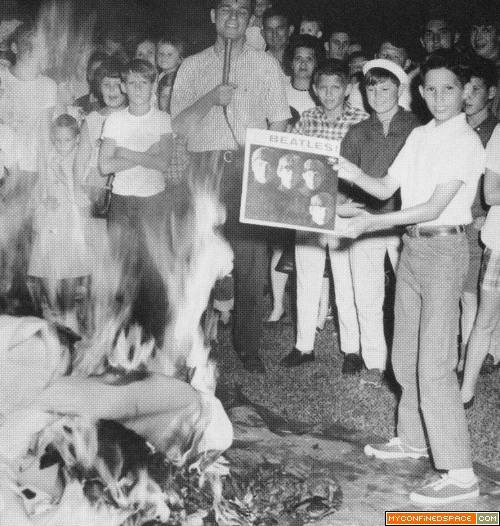
An original, unopened Meet The Beatles album would sell today for about $300-$700. I wonder if the kid in the picture ever thinks back with a twinge of regret...
The ethereal sound was created by laboriously building up multiple overdubs of the voices of Stewart, Graham Gouldman, Godley and Creme singing a single note in unison. This multi-track was then mixed down and dubbed down onto 16-track tape. This process was repeated across all sixteen tracks to create a lush 256-voice "virtual" choir that could "sing" chromatic chords. A number of these prepared multi-tracks were then cut into several endless loops, each of which contained the basic notes of the main chords used in the song. The chorus loops could then be played by using the mixing desk rather like a keyboard -- each chord could be sounded by bringing up the fader for that loop.
The instrumental break featured the repeated spoken phrase: "Be quiet, big boys don't cry...", which was spoken by Kathy Warren, the receptionist of the Strawberry Studios where the band recorded the track...
In this pre-sampler period, the group was able to simulate a large polyphonic choir, creating a dramatic tonal effect similar to that produced by the well-known choir setting on the Mellotron, but with a far richer sound, and in full stereo.
Here's a brief documentary about the creation of the song:
Addendum: I originally created the above post about 10cc's "I'm not in love" a bit over a year ago. Today an interesting item at BoingBoing prompted me to revisit my post, and I discovered that the first video I had embedded at the top of the post has subsequently been taken down. So I've substituted the one from the Boing Boing post (where there is also an extended commentary and additional links).
Illustrated above is the carnyx, a Celtic instrument.
The carnyx (plural: carnyces)... was a Celtic-Dacian variant of the Etruscan-Roman lituus and belongs to the family of brass instruments. It was an ſ-shaped valveless horn made of beaten bronze and consisted of a tube between one and two meters in length, whereas the diameter of the tube is unknown. Archaeological finds date back to the Bronze Age, and the instrument itself is attested for in contemporary sources between ca. 300 BC and 200 AD. The carnyx was in widespread use in Britain, France, parts of Germany, eastward to Romania and beyond, even as far as India, where bands of Celtic mercenaries took it on their travels...
I heard an excerpt of this today as background music in a video about Ernest Shackleton's ill-fated voyage to Antarctica, posted at Scribal Terror. It's a haunting melody; here's the full (17-minute) composition. You can play it while scrolling further down the blog.
I chose this version because I used to work for Indiana University (though not at the Music School).